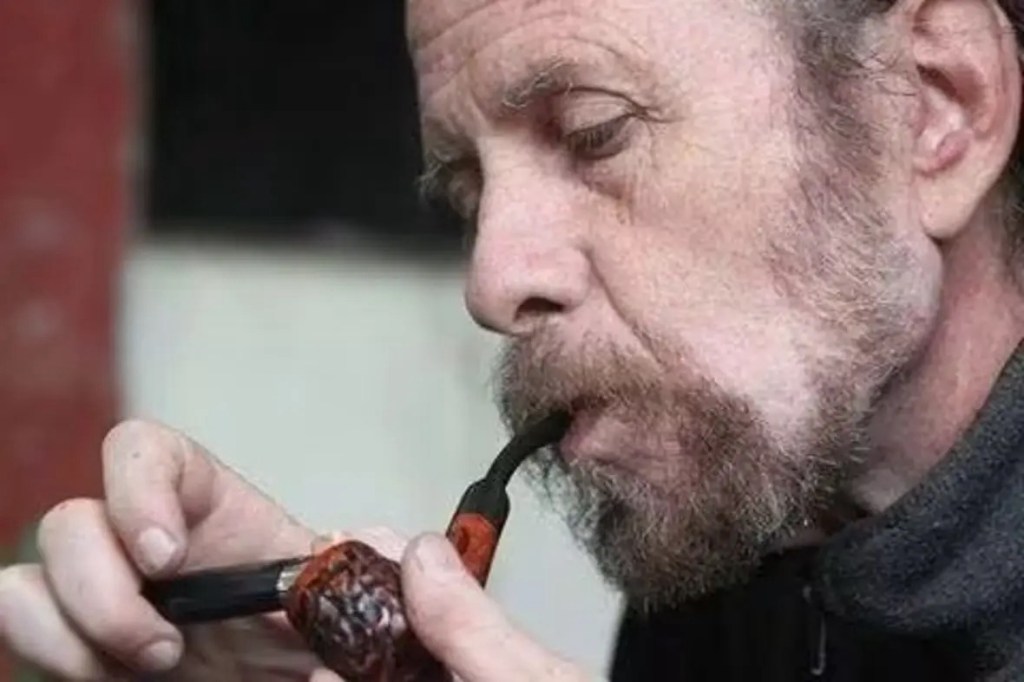
I recently made the acquaintance of Augusto Gen’un Alcade Roshi, a Zen teacher from Argentina. He is also, as it turns out, a lifelong anarchist militant. As a youth in the 1970’s he participated in struggles against the American-backed civil-military dictatorship. Many dissident Argentines were disappeared during these years. Augusto was thankfully never subject to torture and disappearance, he tells me that the danger of disappearance was always looming over him and his comrades.
He has lived most of his life in the cities of Tucamán and Rosario, but spent time abroad studying Zen under a variety of teachers. An especially influential one was Robert Aitken Roshi, founder of the Diamond Sangha and Buddhist Peace Fellowship. Augusto Roshi introduced Aitken Roshi to the works of Kropotkin, which brought an anarchist influence into his and the BPF’s politics. Augusto also studied with the influential Maezumi Roshi on the mainland USA.
Augusto Roshi learned of anarchism as a teenager from an old Italian musician he took lessons with. This teacher was, like many Italian immigrants to Argentina, an anarchist, and he brought a big library with him. Coincidentally (or, perhaps not, as some of my research has shown), this teacher was also influenced by Western Occultism — he was a Mason, a student of Zen, and possibly a Theosophist to boot. From him Augusto got an early taste of mystical spirituality and radical politics. Later, Augusto would begin to study martial arts and Chinese medicine with a local Chinese doctor, which would become his chosen profession as an adult.
Throughout his career Augusto Roshi has worked in support of popular social movements. He is a long-time supporter of the Zapatistas of Chiapas and the Chilean Mapuche independence movement. During the 2000’s economic crisis Augusto supported movements of the unemployed and impoverished neighborhoods with free herbal medicine and meditation classes. He is currently active in a movement to protect social services for the disabled from extreme austerity measures imposed by the Milei neoliberal fascist government.
Augusto Roshi recently sent me these poems. I asked if I could republish it here and he agreed. I think they encapsulate a lot of what “Radical Buddhism” is all about:
There is a way of studying the world that consists of naming it, classifying it, measuring it, and finally administering it. There is another way of knowing it: entering into it so deeply that the separation between the one who knows and that which is known begins to dissolve.
The first way can produce vast libraries, systems of information, statistics, algorithms, and structures of power. The second transforms the way we breathe, walk, see, and act.
In our time, this difference has become decisive.
We live under systems that seek not only to organize production, commerce, or territories. Contemporary imperialism and technofascism also aspire to intervene in perception itself: what we see, what we fear, what we desire, and what we believe is possible. Domination no longer needs only to occupy territories. It can attempt to occupy attention.
A consciousness that is constantly interrupted, stimulated, monitored, and directed may eventually come to live within a landscape constructed by others.
The screen continuously offers what to look at.
The algorithm suggests what to desire.
Propaganda indicates who should be feared.
Advertising determines what appears necessary.
The industry of opinion decides which events deserve outrage and which may disappear in silence.
Thus, the programming of minds does not always need to present itself as a command.
It may appear as entertainment.
It may appear as information.
It may appear as freedom of choice.
It may even appear as an endless succession of choices carefully prepared in advance.
In the face of this, the practice of Zen and attention is not merely a small technique intended to calm the individual.
It is a profoundly political matter.
To sit and remain seated.
To breathe.
To listen.
To watch a thought arise without immediately obeying it.
To recognize fear without automatically turning it into hatred.
To recognize desire without automatically turning it into consumption.
To recognize anger without surrendering the entire body to it.
This is already the beginning of recovering a territory.
Not a geographical territory.
The territory of consciousness.
Shikantaza: An Attention That Cannot Easily Be Colonized
In the practice of shikantaza, “just sitting,” attention is not directed exclusively toward any particular object. The aim is not to manufacture a special experience or attain an extraordinary state. One remains open to whatever appears.
The breath is there.
The sound is there.
The thought is there.
The pain is there.
The joy is there.
The entire world appears without needing to be immediately transformed into an opinion.
This open and inclusive attention possesses a strength that may seem small because it makes no noise.
Yet precisely there lies its depth.
A mind-heart capable of observing a conditioned thought or concept without becoming completely identified with it begins to recognize that not every thought appearing within it belongs to it absolutely.
Fear may have been learned.
Prejudice may have been installed.
Hatred may have been cultivated.
Desire may have been manufactured.
Attention allows us to see the movement before becoming completely absorbed by it.
For this reason, sitting does not mean withdrawing from the world.
It means learning to be in the world without being blindly carried away by every current moving through it.
The mountain does not need to shout in order to remain a mountain.
The river does not need to convince anyone that it flows.
Practice likewise does not need to constantly proclaim its importance.
It sits.
It breathes.
It sees.
And from that intimacy a different freedom begins.
The Kōan as Intimate Inquiry into Life
The kōan may be understood in a similar way.
It is not merely a puzzle intended to be solved conceptually or intellectually.
It is an inquiry that penetrates to the very place where the mind-heart attempts to turn life into an object that can be dominated or controlled.
What is this?
Who are you when your explanations disappear?
What remains when you can no longer take refuge in your concepts?
What happens when inquiry ceases to stand before you and begins to live, pulse, and dwell within you?
The kōan does not provide an answer that can be stored away.
It settles in.
It dwells.
It pulses.
It works in silence.
It accompanies the practitioner while walking, eating, aging, losing, loving, and contemplating death.
In this way, inquiry ceases to be the accumulation of knowledge and becomes intimacy with existence, with living and with life itself.
Inquiry does not lead outside life.
It leads more deeply into it.
And there something fundamental begins to reveal itself: the essential nature of life is not a theory separate from existence.
It is in the breath occurring now, in the changing body, in the tree shedding its leaves, in the suffering of another being, in the injustice appearing before us, and in the response we offer with our own body.
Zen in Movement
Yet the mountain is not realized only by sitting.
It also walks.
The body itself can become a form of intimate inquiry.
In the internal arts, nei chia, learning does not consist merely in understanding abstract principles of movement. The principle must permeate bodily structure.
Relax.
Root.
Suspend.
Empty.
Listen.
Yield.
Respond.
The body learns what the mind alone cannot learn.
A person may intellectually understand that one should not rigidly oppose a force and yet remain completely rigid when that force appears.
Learning begins when that understanding descends from the head into the bones, into the marrow.
Then the body discovers something that no book can fully give.
The root does not oppose the wind.
The bamboo does not defeat the storm.
It adapts without losing its center.
The practice of movement thus becomes a pedagogy of life.
It is not about becoming invulnerable.
It is about learning not to break through the need to remain rigid.
And this teaching, this Dharma, acquires a social dimension.
A community that knows only how to resist blow with blow may eventually reproduce what it struggles against.
A community that knows how to yield without submitting, adapt without losing direction, and remain rooted while the world changes possesses another kind of strength.
From the Individual Body to the Body of the World
Here socially engaged Zen finds one of its deepest possibilities.
If practice seeks to recognize that there is no absolute separation between ourselves and other beings, then social suffering cannot be regarded as something entirely outside practice.
Hunger is not outside the zendo.
War is not outside the zendo.
Exploitation is not outside the zendo.
The destruction of ecosystems is not outside the zendo.
The manipulation of consciousness is not outside the zendo.
All of this appears within the same field of life in which we breathe and pulse.
Yet recognizing this does not mean feeding the Three Poisons beneath a new banner.
The practitioner may oppose domination without cultivating hatred toward those considered enemies.
May denounce falsehood without becoming a manufacturer of new falsehoods.
May resist exploitation without turning resistance into another form of craving for power.
May struggle for life without transforming struggle into a cult of violence.
This is one of the greatest difficulties of socially engaged Zen: acting without becoming completely possessed by that against which one acts.
Clarity must accompany action.
Compassion must accompany firmness.
Attention must accompany indignation.
And wisdom must prevent indignation from becoming blindness.
To recover attention moment by moment is to recover the capacity to respond.
Imperialism requires bodies available to produce, consume, obey, and fight.
Technofascism requires fragmented perceptions, accelerated emotions, and permanent enemies.
The attention economy requires that we never remain too long with any one thing.
Zen practice begins by doing precisely the opposite.
We return.
To the breath.
To the body.
To the ground.
To reality.
To the presence of the other.
Not to escape the world, but to rediscover it.
When a person recovers the ability to remain with an experience without being immediately manipulated by it, that person also recovers a fundamental possibility: the capacity to respond.
To respond is not to react.
Reaction belongs to impulse.
Response is born from presence.
Between stimulus and action, a space appears.
Within that space genuine freedom exists.
One of the most urgent tasks of contemporary Zen is to cultivate that space.
Toward a Horizon of Life
Practice cannot end with an individual experience of well-being.
To sit in peace while the world burns would be too small and too ignorant an understanding of peace.
To move the body in pursuit of self-perfection while other bodies are discarded would be too small an understanding of the body.
To study the essential nature of life without recognizing and embodying the concrete life of beings would be too small an understanding of nature.
The Way must return to the earth.
To community.
To work.
To relationships.
To the protection of the vulnerable.
To the care of water.
To nourishment.
To education.
To health.
To the creation of spaces where people may recover their capacity to think, feel, and act without being reduced to commodities, consumers, or data.
Socially engaged Zen does not need to become a closed ideology.
It must become something both simpler and more difficult:
a practice of clarity amid confusion;
a practice of compassion amid cruelty;
a practice of freedom amid conditioning;
a practice of life amid the forces that turn life into merchandise.
Then shikantaza, the kōan, internal movement, and social action cease to be separate paths.
To sit is to learn not to be swept away.
To investigate the kōan is to penetrate to the root of separation.
To move is to learn through the body the intelligence of transformation.
To act in the world is to carry that realization wherever life is being wounded.
The mountain becomes the path.
The path becomes a step.
The step becomes an encounter.
And the encounter transforms the world once again.
There is no mountain called “I” that must arrive at a summit called “realization.”
There is only this earth rising beneath our feet.
This body breathing.
This world suffering.
This life continuing.
Therefore, when the hands finally release the need to possess a truth, something far vaster remains.
The mountain.
The river.
The body.
Others.
Sorrow.
Joy.
History.
The future not yet born.
All of it breathing and pulsing within a single living reality.
And then it can no longer be said with certainty that there is “the” world over there and “us” over here.
There never was such a separation.
There never was such a “the.”
There is only this vast movement of life, studying and practicing itself in every body, questioning itself in every kōan, awakening itself in every breath, and walking again and again toward a horizon where life may continue to be life.
The only horizon that needs to be dreamed, created, and walked.
Augusto Gen’Un Alcalde
Winter 2026