
Commentary
At the end of her translation of the great Tibetan epic poem concerning King Gesar, Alexanda David-Neel relates this fascinating story about the author’s encounter with an enigmatic Lama in the Changtang desert of northwestern Tibet. While the conversation itself is interesting enough, it could be interpreted in very different ways. For one, if we take it entirely at face value, it demonstrates the presence of an anti-colonial militancy and libertarian spirit among some of the Tibetan intelligentsia in the first decade of the 20th century. This would confirm some of Geoffrey Samuel’s theories in Civilized Shamans regarding Tibetan culture and the Epic of Gesar in particular. In Gesar and his relationship to Tibetan societies, Samuels finds, “an image of a kind of free and creative activity that went well beyond the bounds of the centralized and hierarchical state. It may indeed be argued that in the epic, as ideally within the ‘untamed’ regions of east Tibet where Gesar’s activity was centered, the role of shamanic power was not to create a state, but to maintain freedom from the state. Gesar’s wars were wars of defense against hostile powers who desired to subdue and defeat the people of Ling (i.e., the Tibetans).”
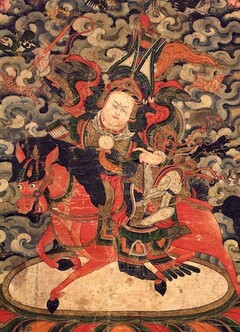
Jamyang Khyentse Chökyi Lodrö writes of Gesar, who also serves as a protective yidam1 in the Nyingma Dzogchen tradition “To put it simply, Gesar is a manifestation of Mañjuśrī; a messenger of Padmasambhava; a dance-like emanation of the activity of the dharma-king Tri Song[detsen]; a great vidyādhara who achieved immortality as a direct disciple of Lang Ami Changchub Dreköl; a warrior-spirit for the whole of Jambudvīpa; a refuge and protector for all practitioners, who is outwardly powerful and inwardly caring; the wealth-keeper of China and Tibet; and the great scourge of foreign armies and invaders.”2
On the other hand, we can also read this story as David-Neel’s own editorializing. Perhaps it is based on a real conversation she had, or perhaps not. If it is on the whole more her creation, it allows us to see the state of her political ideology some twenty years after she dropped out of the French illegalist anarchist movement. In her journalistic and scholarly work she scrupulously avoided politics as much as possible, and European politics especially. But I suspect that in her case she remained an anarchist, at least in spirit. This would have been among the few places she allowed herself to speak her mind —through the mouth of a Tibetan interlocutor — sending a stern warning to the Europeans and Americans who were the primary audience of her articles and books: Do not fuck with Asia, where , slowly but surely, under the yoke of colonial rule, “men are waking…”
Although the final paragraphs unfortunately make use of the “yellow peril” trope, a racist stereotype of Asians commonly held by whites at the time, on the whole the tone of the chapter is unambiguously anti-colonial and revolutionary. Especially interesting are the ideas of the unnamed Lama/David-Neel regarding the collective nature of the millenarian hero’s return, his approach towards violence, and his opinions of, “the masters who insist on remaining masters,” and, “the slaves who persist in remaining slaves and in keeping others in slavery.”
I don’t know which interpretation is correct. Having read a lot of David-Neel’s work, I suspect it is a bit of both. As a scholar and translator she was quite strict about reporting the facts as received. But as a writer her unique and often abrasive personality is what puts her above the rest of the orientalists of her generation. It might be best in this case to regard this chapter and its message as an authentic fusion of the Asian and European radicalism which pervaded the environments in which David-Neel spent decades traveling and reporting on — sometimes in sedan chairs, accompanied by swarms of servants; other times among the commonest people: penniless, fugitive, female, and on foot.
In the words of the unnamed Lama, “Nyi su med pa. Nyi su char med to (It is not two. It is not to be made two)”.
Excerpt From: Alexandra David-Neel’s “The Superhuman Life of Gesar of Ling.” Chapter 14
“A MAN!’
‘Get your rifles!’
‘Bring in the beasts!’
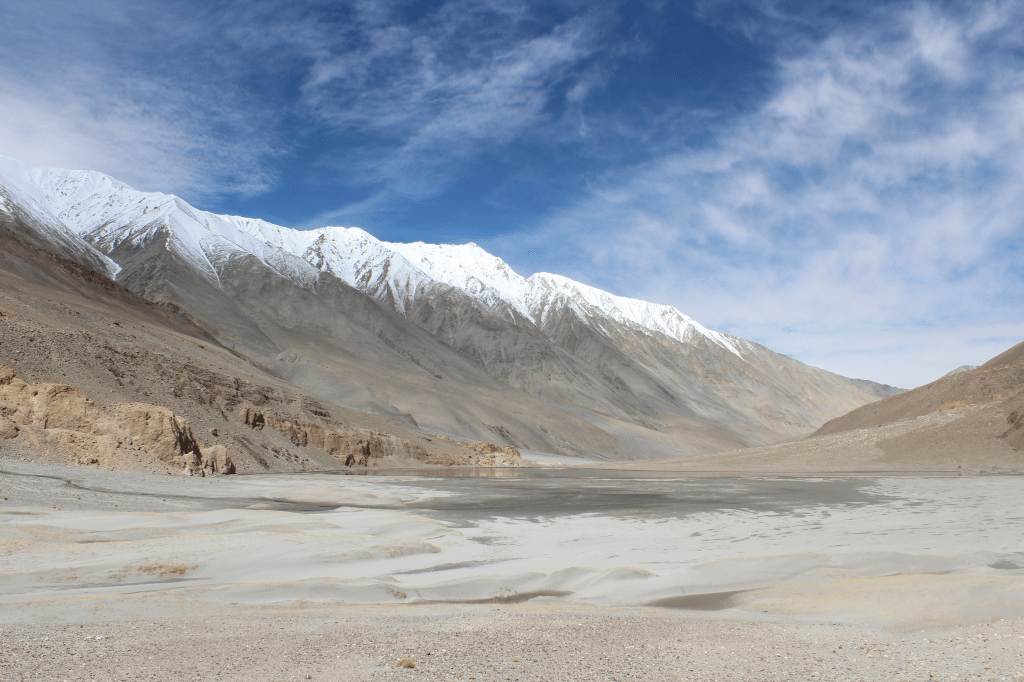
These three exclamations following one after the other drew me out of my tent. I was in the wild and fascinating country of the great lakes, in the Chang Tang desert. My four Tibetan servants had just pitched our camp on a grassy spot where mountains bordering an immense tableland bent inward and formed a crescent-shaped recess. We intended to pass the night there, sheltered from the wind. We were not following the caravan tracks, and if along these, travellers are few, they are completely missing in the regions through which we were passing. The sudden appearing of this man was very strange. For many days we had not seen anything in the way of living creatures, except wild asses and bears. Moreover, everywhere in these solitudes, man suspects man. The instinctive gesture of anyone upon seeing another of his kind is to seize a rifle, and, if he is under canvas, to bring in nearer to the camp the animals that are grazing round so as to protect them from the ‘thief!’ However, these little details take nothing from the charm of the Chang Tang: life is delicious there.
Motionless, on the top of a mound, a horseman gazed at us from the distance. I examined him through my glasses.
He was seated upon a superb horse, white as snow. The animal’s trappings, doubtless ornamented with silver, glittered in the sun. The rider wore a yellow robe, and his hat, also yellow, was bordered with fur. He carried no visible weapon.
‘Put your rifles away,’ I said, ‘there is nothing to fear. He is a Mongol lama.’
‘Or he is a brigand who has robbed a lama and put on his robe so as to be able to approach merchants without rousing their suspicions. Perhaps he is the scout of a robber band,’ queried one of my servants.
‘Caravans do not pass this way, what would brigands do here?’
While we were speaking, the traveller rode down from his grassy pedestal and came towards us through the meadows.
He was young and had a grand air. He probably overawed the servants, for they went forward to hold his horse’s bridle. Then, yielding to force of habit and forgetting at the sight of his rich ecclesiastical costume the doubts concerning his honesty to which they had given voice, they prostrated themselves at his feet and begged for his blessing. He, with the detached manner of a dignitary accustomed to receive such marks of respect, lightly touched their heads with the tips of his fingers and said in a sharp tone:
‘My trapas (monks) follow with the luggage. One of you go and meet them in the direction from which I have come and lead them here.’
Then moving towards me, he smilingly offered me a silk scarf, saying:
‘You are Jetsun Kuchog (reverend lady), who has lived many years in Kum Bum and has stayed a long time in Kham and in Kyirku,’ His tone affirmed rather than questioned.
‘Oh!’ I remarked, ‘you appear to be well informed concerning me. How is that? And who are you, Kushog?”
‘I come from Kham, my country. Some merchants from Hor Kanze and others from Kyirku whom I met, the lama of Lob, Dzogschen Pema Rigdzin, and several more have spoken to me of you. It seemed to me so strange that there should exist a foreign naljorma,3 that, having learned from the Gologs4 you had passed this way and were travelling in these parts, I came in search of you.’
Tea was boiling on the camp fire, so I invited the Lama to drink a cup with me in my tent while he waited for his luggage to arrive.
We began a friendly conversation.
Born in Eastern Tibet my guest had been recognized when a child as the reincarnation (tulku) of a Mongol lama, of no great renown, it seemed, but the possessor of ample means—as there exist thousands in that country. His ecclesiastical seat was a little monastery situated near the Turkestan frontier, which he called the ‘Monastery of the Secret Liberation’, but he lived, he said, nearly always under canvas. He liked travelling, a taste he had in common with a great number of Tibetan monks. After studying at the Depung monastery in Lhasa, he had travelled over a part of India and Nepal, visiting the various places of pilgrimage. Later, he had been in China as far as Pekin and in Siberia as far as Irkuts.“He was curious regarding the object of my travels. Why, as he had been told, did I go from monastery to monastery, propounding to the lamas difficult questions concerning ‘very deep points of the Doctrine’. While explaining my reasons I took the opportunity of also questioning him, and I came to the conclusion that he was a passable scholar.
His luggage arrived with his servant trapas. They pitched some fine tents. A beautiful carpet and thick cushions that served for couch furnished the one occupied by the tulku. In comparison with his camp, my very humble one took on a rather mean appearance.
It was my turn to be invited. I had supper with the lama: tea, tsampa, cold boiled mutton, dried meat, dried apricots; a grand menu in the Chang Thangs.
My host would have liked me to give him details of the war that had convulsed Europe, but, living in regions where the post does not visit, I was not much better informed on that subject than he.
‘Do you believe,’ he asked me, ‘that from this war among the foreigners some good may come?’
‘None; on the contrary, much evil,’ I answered with conviction.
‘It must be so,’ he acquiesced, ‘because these people fight for selfish motives and not for religion.’
It is necessary to realize that the Tibetan term chös5 admits of a number of interpretations. It signifies religion, philosophy, metaphysics; also the universal law not imposed but inherent in things, justice, rectitude, equity, and all that is excellent; and, further, the word ‘thing’, which in itself is capable of many applications.
‘There is no more religion anywhere,’ he declared.
‘How can you say that,’ I protested. ‘Did you not tell me that you had been a student in the Depung monastery? Are there not about ten thousand monks there? Are there not thousands also in Sera, Gahlden, Tachilhumpo, and in many other monasteries? It is strange that a Tibetan should say that there is no more religion.’
‘It is true that monks are not lacking,’ he replied, ‘but the clergy, they are not the Religion. The Brahmins of India, the popes of the Orossos (Russians), the padres of the Philings (foreign priests and ministers), the lamas, they are all one. They are Mara’s6 army, who dupe the feeble-minded,7 crush them, and make them more foolish still.
‘The Chinese monks are perhaps the least harmful. The majority of them are very ignorant, but they are often kind-hearted.
‘However, all of them spread false doctrines that are injurious to men and are the cause of suffering.
‘Religion is the search after truth. It is illumination of the mind, right judgment, and the right action that springs therefrom.
‘What is to be gained by putting one’s foot on another’s neck? He who does so is but preparing for the crushing of his own neck under the foot of another who is stronger than he.’
‘Those who are ground down by the mighty have no more religion in their hearts than have their oppressors; they are wicked, malicious, and cowardly. If they become powerful they behave in the same way as those whom they now curse.
‘Nevertheless, we people of Tibet, of Mongolia, of China, we are capable of leaving the false path, because we know the power of thought and respect it. We still know how to meditate, how to pass consciously out of this world and look at it from above.
‘The Whites do not know how to do this. They only know how to invent strange machines, of which they are very proud, and their machines will destroy them. The destruction has already begun and will continue. The Tökuo (Germans), the Fakuo (French), the Yinkuo (English), and all the rest will exterminate one another.’
‘Unless Gesar takes the matter in hand,’ I said, having at the time my mind full of the Epic, which I had just noted down.
The Lama looked at me curiously.
‘Oh! you know the story of Gesar. . . .’
‘Yes. I have been told that he is coming back to lead a great army to the West.’
‘Do you believe it? . . .’
‘All is possible.’
‘He will be reborn among us. The power of our united thoughts will “construct” him. He will be the tulku of the minds of all of us whom the philings (foreigners) wish to make their slaves.’
“He will hold a sword in each hand with which to mow down the enemy on either side,’ I continued, quoting some words of the poem chanted by the bards.
‘Do not jest. The sword can be symbolic. Its blade can emit invisible sparks, which will penetrate people’s minds and transform them. Among those who will have been given arms to use against us, some will throw them away, whilst others will turn them against the demon enemies of justice and the happiness of beings.
‘The true Religion will be preached, and those who refuse to act justly: the masters who insist on remaining masters, the slaves who persist in remaining slaves and in keeping others in slavery. . . .’
“He ended with a significant gesture.
‘I understand,’ I said, ‘Gesar’s sword . . .’
‘But, Kushog, what is religion, according to you?’
‘Nyi su med pa. Nyi su char med to8 (It is not two. It is not to be made two),’ he answered. ‘The hand must not injure the foot; they are the same body.’
‘But then, by destroying the masters and those who will persist in playing the part of slaves, Gesar will cut into this one body.’
‘Do not your surgeons cut away decayed pieces of flesh from the sick in order to cure them? But, these surgeons throw away the decayed pieces without troubling themselves as to what becomes of them; such a procedure only displaces the cause of evil. Gesar, on the contrary, sent to paradises the demons whom he killed in this world.
‘This chi powa9 (change of world) is the transmutation of the essence of the mind: that is to say, the diverging of a current of energy into another channel in order to bring about another kind of activity. You ought to know this, you who have questioned so many lamas. The demon mind must become divine mind. Dispassionately, we will kill to heal.’
He said we. Indeed, his words had already sufficiently revealed his feelings, but he now showed the intention of an active participation.
‘And, will you be a great many?’ I asked.
“Millions and millions,’ he replied. ‘The hatred of the Whites grows and spreads as a flame in dry straw.’
‘If I am still in this world when these things happen I will ask Gesar’s permission to accompany his army as war correspondent.’
The latter term naturally not existing in Tibetan, I had said it in English.
‘Whatever is that?’ asked the tulku.
‘It is the one who follows the troops in order to give information to the newspapers of the events that are taking place.’
‘There will be no more newspapers,’ declared the Lama, in a superior and disdainful tone towards an institution that he evidently regarded as obsolete. ‘Gesar will send his messages “on the wind”.’
Doubtless he meant a wireless telegraphy brought to greater perfection than ours. Whatever may have been the Lama’s ideas concerning a reconstructed civilization, I could see that they did not tend towards barbarism.
“Night had long since fallen. The luminous night of Central Asia, with its thousands of stars glittering intensely in a mistless sky.
I took leave, and retired to my tent.
Before dawn next day the trapas folded the tents and corded their luggage. The tulku and his attendants were ready to start as a faint pink showed in the east.
We wished one another a good journey, and the men rode away. Soon after their departure the sun rose, encircling with a nimbus of gold light the little party that advanced with it towards the still shadowy west.
The conversation of the previous evening, still fresh in my memory, these horsemen moving across the desert, conjured up in my mind the image of Gengis Khan and his hordes. Would a Gesar really rise in the Yellow country to muster other troops less primitive than were their predecessors, better informed and more terrible than they? Following the path of the sun, even as these travellers that were disappearing over the horizon, encircled as they were with a golden light, would the future army progress to ‘renew the face of the earth’ by a purifying destruction?. . .
I thought of the children of the Whites, sleeping at this hour in their cots. Of those who, during the course of this very day, would gambol joyously in the gardens of our great cities, without a thought of what the future might have in store for them in the depths of the little known Eastern solitudes, where men are waking. . . .
Footnotes
- Editorial note: Vajrayana meditation deity. For an example of Gesar-in-action, see The Swift Accomplishment of Enlightened Activity through Invocation and Offering by Mipham Rinpoche, which calls on Gesar, as the spontaneous and free activity of one’s own enlightened mind, to, “carry out completely whatever wrathful direct actions we request of you…” ↩︎
- Editorial Note: https://www.lotsawahouse.org/tibetan-masters/jamyang-khyentse-chokyi-lodro/concerning-gesar-rites ↩︎
- ADN: Naljorpa, feminine naljorma (rnal byor ma) is the name, in Tibet for a particular kind of mystic. ↩︎
- ADN: Tribes inhabiting N.E. Tibet. ↩︎
- Editorial note: The term she is referring to is the equivalent of Sanskrit dharma (Pali: dhamma) which has these and even more meanings. ↩︎
- ADN: Mara = demon. ↩︎
- ADN: The Tibetan term lkugspa, pronounced kukpa, signifies stupid, foolish, feeble-minded. ↩︎
- ADN: Words taken from a famous philosophic work: Sherab kyi pharol tu byinpa (pronounced chinpa), the Tibetan translation of the Sanskrit work: the Prajñā Pāramitā. These words are often quoted in Tibet. ↩︎
- ADN: Written phowa. ↩︎

