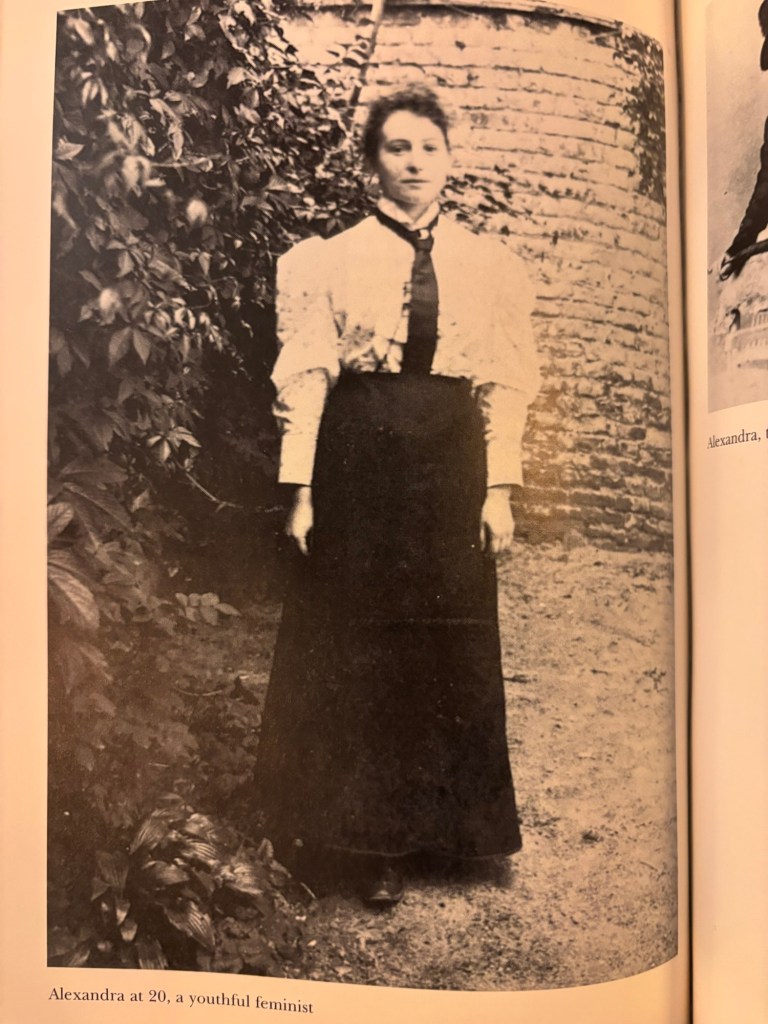
Alexandra David-Néel’s importance as an early explorer, student and translator of Sanskrit and Tibetan Buddhism cannot be overstated. Her books remain today some of the clearest and most intimate expositions of Tibetan Buddhism as it was practiced in Tibet at the start of the 20th Century. She was perhaps the first European to write about Tibetan Buddhism as a sincere student rather than an academic, critic or aspiring guru.
The Secret Lives of Alexandre David-Neel by Barbara and Michael Foster makes the most thorough investigation of her early life of any English biography I have encountered. What most works about her mention only in passing is that in her youth Alexandra was a militant anarcha-feminist with an extensive police file. The Fosters speculate that she was involved in a terrorist cell, possibly as a courier for stolen funds, at least until the assasination of President Sadi Carnot in 1894 and the subsequent anti-anarchist repression.
Alexandra was also the protégée of the rather famous Communard and anarchist geographer Elise Reclus, a neighbor of her father in the suburbs of Brussels. Reclus introduced her to his wide web of radical, scientific and bohemian associates (possibly even Uchiyama Gudo’s comrade Ishikawa Sanshiro, a refugee from Japan following the High Treason Incident). She rubbed elbows with members of the Theosophical Society in Paris and London, and through her studies developed an affinity for the Buddha after seeing a statue in the Musée Guimet which she developed a habit of saluting and speaking to.
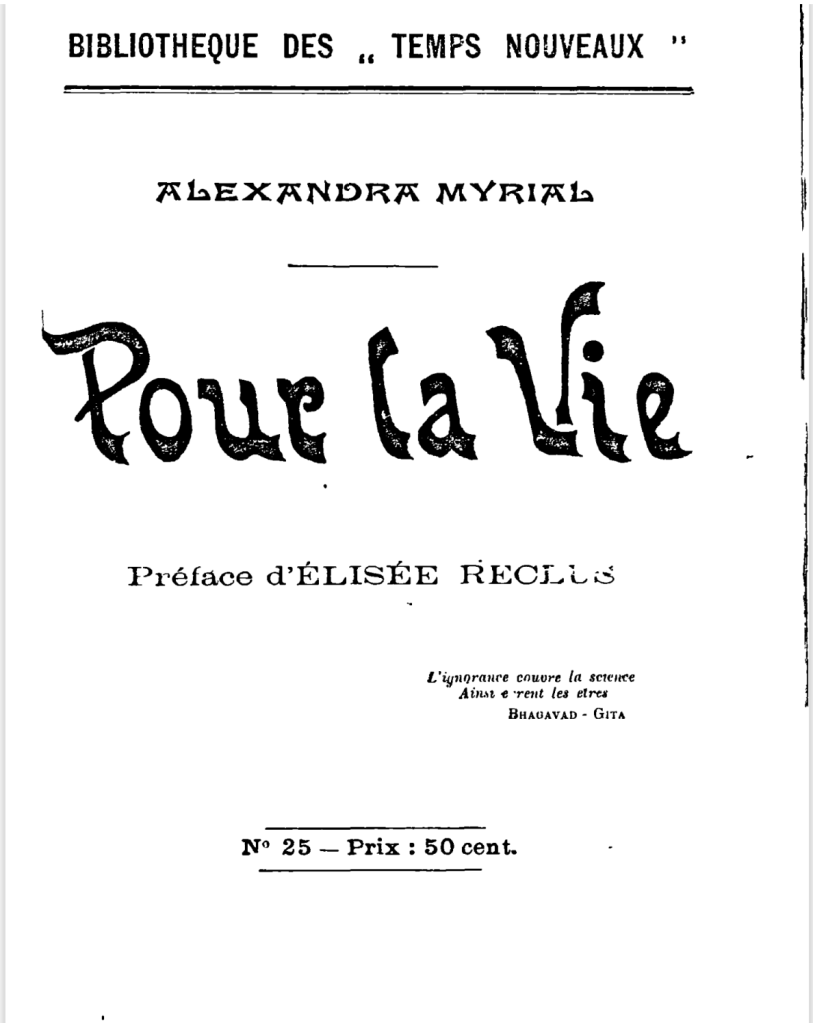
Alexandra (under her stage name Myrial) was the author of a pamphlet, Pour La Vie (For Life), an “anarchist hymn to life”, as they describe it. Reclus encouraged her to write it and wrote the introduction himself. It seems that in her later career as author and adventurer, she kept quiet about her anarchist youth, and so most biographers gloss over it. But needless to say, I was intrigued. After some serious googling, I was able to track down a digitized copy of the original French pamphlet. I’m not sure if an official English translation has ever been produced.
I suspect that reading Pour La Vie can give us some insight into how her anarchist youth influenced her adventurous and studious middle age, and how it colored her translation of Tibetan Buddhism to the West. Her works certainly retain a casual disdain for pomp and authority. And her libertarian spirit no doubt gave her the drive to embark on a 20-year solo journey into the Himalayas. She described herself in those years as a sort of “rational mystic”, an attitude which I think is common in many of the countercultural Western Buddhists who her books inspired. Allen Ginsberg, for example, cited her Magic and Mystery in Tibet as one of his favorite works on Tibetan Buddhism. Reading its dramatic tales of adventure, sorcery, necromancy, telepathy, and their seamless integration with the everyday lives of Tibetans it is not hard to see why poets like Ginsberg adored it.
I suspect that her nascent interest in Buddhism had no small influence on the text of Pour La Vie itself (note also the Bhagavad Gita quote on the cover, “l’ignorance couvre la véritable science, égarant ainsi les créatures”, “Ignorance obscures true science, thereby leading creatures astray”). And I am probably not the only one who sees a similarity between the lines “All beings in Nature strive toward Life; all seek, according to their faculties, the enjoyment given by satisfied need; all flee suffering—privation, which is a restriction, a diminution of life.” and the famous lines in the Dhammapada, “All tremble at violence; all fear death. Putting oneself in the place of another, one should not kill nor cause another to kill. All tremble at violence; life is dear to all. Putting oneself in the place of another, one should not kill nor cause another to kill.” Alexandra’s response to the socialized violence she saw around her was anarchism: “True social harmony cannot arise from submission, but from the free coordination of needs. When individuals are able to satisfy their needs without harming others, conflict disappears of itself. Violence is born not from liberty, but from privation.” Read together we see a simple yet powerful Buddhist social ethic in Pour La Vie, which is itself not all that distinct from the typical anarchist sentiment of the 1890’s.
Having had some success in making AI translations of the articles about Shin Chae-ho, I decided to give it a try for Pour La Vie. As with before, this is not an official or definitive translation. I caught the bot in several stupidly obvious errors (It hallucinated three entire chapters that it just “thought” should be at the end!), but there could certainly be some more that slipped by me. So, read with an open mind and a dose of skepticism as always.
PREFACE
This is a proud book, written by a woman prouder still.
For Life therefore needs no preface; my words here will be entirely superfluous. I offer them nonetheless, since I have been invited to do so—only as a friend, and merely to hum, in a subdued tone, a few notes in unison with the beautiful voice that sings to us, harmoniously, the Hymn to Life.
“Man, where will you go?”
— “Beneath the Sky!”
“Where will you live?”
— “Upon the Earth!”
“Who will guide you?”
— “Myself!”
Such is the theme, in its audacious simplicity! That is well; and I too am happy to sing life—this life that will be so good… when all shall have bread and freedom.
Meanwhile, let us not forget that we shall never be able to conquer that bread and that freedom for all so long as we remain cowards—daring not even to think our own thoughts and to live our own lives; so long as we encumber our morality with prejudices, with false respects and false duties; so long as we avoid conducting ourselves bravely, in a fine harmony with our true nature.
When we are told the story of Hindu widows who made it a pious obligation to mount the funeral pyre of their husbands, we display a naïve astonishment—as though we ourselves were not beings sufficiently deranged to offer ourselves up as voluntary victims, to commit suicide, not for the sake of a noble work, but by virtue of foolishness, vanity, or lies. What would remain of each of our existences if we were to subtract the hours during which we have simulated a mentality and a morality that are not our own?
We are accustomed to wearing a mask, so much so that it seems strange to us to let our true face be seen, to proclaim in a frank and personal voice what we know to be the truth. Through weakness of will, we do not even have the chance to be good when we would wish to be so. It seems more “distinguished” to us to be banal, neutral, mediocre—to bend ourselves to the recipes of domestic virtue and good form, as they are taught beneath the dome of the Institute!
But the times will come when the song of triumph of our friend will be heard, when we shall understand the frank voice that calls us to live sincerely and joyfully our true life; and we shall repeat with her:
“The aim of man is to be himself;
The aim of his life is not to be dead while seeming to live!”
— Élisée Reclus
FOR LIFE
From the moment an organism is constituted, all its forces tend toward a single end: to maintain its personal existence by nourishing it and by defending it against every influence capable of destroying or diminishing it.
All beings in Nature strive toward Life; all seek, according to their faculties, the enjoyment given by satisfied need; all flee suffering—privation, which is a restriction, a diminution of life.
In the period of earliest childhood, man still unconscious—or rather, not yet having deformed and falsified his normal consciousness—follows, like other beings, this universal tendency. Later, yielding to the suggestions of example, to the false notions taught to him, he comes to subdue his nature, to master the impulses of his personality, to allow influences hostile to his own life to act without resisting them. But how many revolts has this renunciation not been preceded by! One would have to have never seen a child grow up to be ignorant of the struggles that the natural sentiment of self-preservation and the satisfaction of instinct arouse between the child and the educators who seek to shape him.
So long as the doctrine of the Fall of Man prevailed—man considered as having fallen from a primitive perfection and plunged into a state of moral infirmity that only the light of a divine revelation could remedy, prescribing to him a rule of conduct opposed to the solicitations of his being; so long as, dominated by the prejudice of the separation of spirit and body, it was believed—according to the expression of Christian texts—that one must “hate the flesh,” glorify death by martyring the body, and give predominance to suffering over enjoyment—this was the logical consequence of the religious conception in which faith was placed.
The study of Nature has swept away all these ancient legends. Man is no longer that fallen being compelled incessantly to repress the voice of a perverted instinct. No more than any of the beings existing in the universe does he have reason to detest or despise his body and the thought that emanates from it. Science shows us nowhere a law existing outside the inherent properties of the elements of matter and implying man’s adherence to a rule for which he finds no sanction within himself, in the needs of his organism.
This cannot be repeated often enough: the single law of beings, demonstrated and confirmed by study and experience, is the desire for life—the search for the satisfaction of all their faculties as a means of living fully—and the struggle against suffering, whatever its form.
Man has no reason to believe himself outside this universal law. The most perfected of known beings, he feels within himself, like the humblest of his brothers in existence, an ardent and imperious desire for intense life—without diminution, without restriction. An incredible perversion of judgment alone has been able, until now, to make him accept a weak, sickly life, bent beneath constraint, accepting pain without revolt.
Let him rise today in the name of this sentiment despised by centuries of ignorance; in the name of Instinct disdainfully abandoned to animals, while man—taking pride in his immaterial Soul or Spirit—gave proof only of his unconsciousness. Let each follow everywhere and always the impulse of his limited or his genius-endowed nature, whatever it may be. Then, and only then, will man know what it is to live, instead of despising Life without ever having lived it.
OF AUTHORITY
Obedience is death. Every instant in which man submits to a will foreign to his own is an instant taken away from his life. When an individual is constrained to perform an act contrary to his desire, or prevented from acting according to his need, he ceases to live his personal life; and while the one who commands increases his power of life by the force belonging to those who submit to him, the one who obeys annihilates himself, dissolves into a foreign personality—he is no longer anything but mechanical force, a tool in the service of a master.
When authority is exercised by one man over other men—by a despotic sovereign over his subjects, by an employer over his workers, by a master over his servants—it is immediately understood that this personality employs the life of those who are subjected to him for the satisfaction of his pleasures, his needs, or his interests; that is to say, for the embellishment and extension of his own life at the expense of theirs.
What is generally less well understood is the baleful influence of authorities of an abstract order: ideas, religious or other myths, customs, and so forth. All outward manifestations of authority nevertheless have their source in a mental authority. No material authority—whether that of laws or of individuals—possesses its force and its reason within itself. None truly acts by itself; all are based upon ideas. And it is because man first bows before these ideas that he comes to accept their tangible realization in the various forms assumed by the principle of Authority.
Obedience has two distinct phases:
- One obeys because one cannot do otherwise.
- One obeys because one believes that one must obey.
In the almost animal state of life in which the earliest humans lived, the will of the strongest was the supreme law before which the weakest were compelled to bend.
“I will,” says the one who feels strong enough to compel another to obey him.
This constraint implies no moral sanction. One wills because such is one’s pleasure; the other obeys through fear of violence. If he can place himself beyond the reach of reprisals, the one who obeyed through fear hastens to act according to his own will—happy in his freedom, ready in turn to impose his will upon someone weaker than himself. This domination by physical force cannot truly be called authority: it is only a passing, purely material constraint, not accepted by the will of the one who obeys.
Only domination exercised in the name of abstract ideas—by the weaker over the stronger, and accepted by the latter—constitutes authority. One then enters the second phase: one obeys because one imagines that it is necessary to obey.
When the conditions of their environment allow men to begin to reflect, certain among them—those whose mentality is the most developed—experience the desire to make others obey them, either from purely selfish interest, or, more often, because, having formed an ideal of life that seems to them suited to the group of which they are a part, they wish to see it realized.
But without science to prove and demonstrate, guided only by vague experiences, a few superficial observations, and above all by imagination, how will they be able to subjugate the masses around them, whom they cannot master by physical force?
Then their inventive spirit exploits ignorance, the terror of men anxious amid an incomprehensible and terrible Nature. The gods are charged with bringing to men themselves their rule of conduct.
The fear inspired by the unknown in coarse minds thus extends to those who speak in its name—to those who explain the law and demand its observance in the name of the gods.
Here is the first authority founded on cunning and based on chimeras. Man accepts it through ignorance; and through ignorance as well, he will accept all those that will be born thereafter.
By these mysterious laws, presented as the expression of an extra-terrestrial will, religious leaders came to command man—no longer by saying to him “I will,” which addressed itself to the body and from which he could attempt to escape, but by saying to him “you must.”
No flight was now possible in order to live freely beyond the presence of the chief feared for his physical vigor. Man henceforth bore within himself an invisible constraint: the will of the god, carried like a burden.
Whether he goes or comes, in all places and at all times, his memory repeats to him what he must do or avoid. He has been taught to discern Good and Evil.
At all times, man—like all beings—has distinguished things that procure satisfaction from those that produce suffering. This natural Good and Evil no one needs to teach him. But, leaning upon the will expressed by the god—an incomprehensible and indisputable will—men endeavored to make him accept as the expression of Good: passive resignation, blind submission, pain, renunciation of the most natural aspirations—evil, in short, under all its forms.
Official Evil became life itself, with all its desires and all its joys; its need for freedom, its curiosity about things, its proud revolts, its horror of suffering—everything that is Beautiful and True.
The first codes, written or unwritten, differed greatly according to the environments and races in which they were born and underwent numerous modifications in relation to the evolution of societies. But whatever the laws and social powers before which men bow, it is certain that their force is subordinated to the acceptance of a moral code.
The man who, through a perversion of natural sense, believes in Good-as-suffering, in unpleasant Good, and in Evil as a source of enjoyment, alone understands the necessity of an organization destined to impose Good by force and to repress by violence those who might be tempted to give themselves over to Evil in order to derive satisfaction from it.
In the struggle produced by the antagonism between the true interest of the individual and the rule of conduct to which he believes he must conform, man becomes accustomed to constraint and is ready to accept it when it manifests itself as an external authority. No doubt he battles and debates; Good and Evil differ from individual to individual, from people to people. One takes pride in what another condemns. But the principle remains invariant at bottom.
If one wishes to overthrow the morality of one’s neighbor and the authoritarian apparatus by means of which it imposes itself, it is only in order to replace it with one’s own morality—which, like the other, will need to be imposed by force upon those who do not accept it.
As there are always many points in common among people of the same race, one generally prefers to sacrifice something of one’s own conception of Good and preserve the guardians of one’s adversaries’ code—provided that one avoids the common enemy: the truly free man, acting according to his need, without submitting to anyone.
If the less ignorant man had confined himself to the distinction he feels so deeply within himself—the Useful-Good and the Harmful-Evil—he would little by little have progressed by seeking the best means of avoiding suffering and satisfying his material and intellectual needs. He would have had hygienists, inventors, scholars of every kind. His credulity, however, made him bow before the so-called wills of chimerical beings: he had priests, kings, warriors, politicians; he suffered, wept, martyred his flesh to save his soul, and sacrificed his existence to pretended social duties.
In our modern societies, authority no longer officially rests upon a divinity. Much is still said about Good and Evil, but in fact the observance of so-called moral laws (since they are no longer called divine) is not obligatory. Of the Good, only what legislators judge useful and profitable to the social order of the moment is retained.
Virtue is always recommended in fine speeches, but vice is very well received.
No one asks you anymore to save your soul; it suffices to be an honest man—that is to say, to act according to the will of legislators in the outward acts of life.
Restricted as this conception may be, it suffices to make many victims: honor, patriotism, and other secular virtues have killed as many men as the gods of former times. It will remain so as long as man seeks his rule of conduct outside science—the only thing capable of enlightening him as to his real interests: the only authority that exists.
The first legislators, imposing their codes in the name of the gods, did not have to justify their morality. Men accustomed to obeying force submitted once again, through fear of a force greater than their own.
By ceasing to believe in gods, man—delivered from his terrors—should logically cease to obey anything that is not in harmony with his interest. Far from it.
A long heredity has created within us a tendency to repeat the acts of those who preceded us; our physical constitution, recalling that of our fathers, predisposes us to act and think like them. These predispositions are further reinforced by the effect of an education directed in the same sense. There would be nothing remarkable in this had not man’s ignorance transformed this simple habit into a particular sense—Conscience—whose organ no anatomist, moreover, has ever found beneath his scalpel.
For believers, Conscience is the voice of God speaking within us. For others—for non-believers also speak of their Conscience—what can it be if not the result of dispositions particular to each organism and a function of memory?
The gods may disappear; humanity has replaced them. For its own enslavement, it has invented the secular god—the intimate tyranny: Conscience.
Yet under the violent incitements of instinct, man at times rediscovers the irresistible inclination toward Good—that is, toward enjoyment; and then, despite restraints, he lives a minute in the act of his own choosing. For a minute, he tastes life; but soon all the prohibitions he has been taught return to his memory. Unaccustomed to living freely, he soon becomes frightened at finding himself alone, outside the boundaries between which he has accustomed himself to walk.
This memory of rules taught to him, this discomfort at having acted otherwise than usual, all this trouble seems to him the reproach of his indignant Conscience. Nothing harmful has happened to him, and yet his joy is spoiled.
An artificial sentiment—remorse—makes him suffer without cause. He accuses himself of his act, calls it a fault, a sin, a bad action.
And why is this action bad? If it has caused harm, suffering, it is understandable that man should regret it; this regret will be the starting point of an experience serving him to avoid injuring himself again in similar circumstances. But if the action has been useful to his life, if it has procured him strength or contentment, is it not rather the good action?
Every conception born of the imagination tends to incarnate itself in a physical form. Thoughts engender acts; philosophical systems engender social organizations. The inner tribunal—Conscience—gives birth to judicial authority, to the judge; remorse and voluntary expiations lead to the acceptance of coercion.
If man had not accustomed himself to scrutinize his acts, to weigh them on any balance other than that of his real interest; if he had not blamed himself and declared himself guilty so many times, how could he admit that another man might come to demand an account of his conduct, erect himself as a censor of his actions, to absolve or to punish him?
Belief in guilt is the foundation of this entire system. Man believes himself guilty; he believes that other men also make themselves guilty; and from this he concludes the necessity of a repressive power.
As for determining which acts are reprehensible, the matter is less simple. Each person conceives Good and Evil differently; thus the famous “Voice of Conscience” speaks differently according to each individual. This cacophony would be well suited to bringing men back from their error if they wished to pay attention to it; but the majority believe in an abstract, immutable justice of which their Conscience is the echo. In the name of this justice they demand from judicial power the sanction of Good and Evil.
This conception of justice, too, assumes in its details a particular aspect according to each individual; and each, naturally finding his own opinion alone to be true, qualifies as injustice everything that deviates from it.
Such confusion ought to show men the vanity of everything that is not based upon experience; yet it does not suffice to dispel their blindness. They continue to demand justice, as they demand direction—and once again reap nothing but constraint.
What is the sentence rendered by a magistrate, in the name of the law? It is constraint exercised upon an individual to compel him to conform—or to punish him for having infringed—the will of a few hundred parliamentarians whose function is to legislate. If tomorrow these men change their opinions or give place to others, those others may make different laws; and the judge, pronouncing other sentences, will proclaim another justice.
When a jury is called upon to rule upon the act of an accused person, does one not also see that the personal ideas, character, physical constitution, and momentary dispositions of the jurors are the sole bases upon which the judgment is rendered? Change the jurors, and the individual acquitted by some will be declared deserving of capital punishment by others.
If Good and Evil, justice and injustice, are not immutable—eternally identical; if these ideas, like all others, are subject to the variations imposed upon them by men and environments—by what right can one blame the particular conception formed by an individual? His conception may be that of yesterday; it may also be that of tomorrow. In no case can you persuade him that he transgresses the law of Good or that of Justice, since from the moment a single modification has been produced in these ideas by human action, all those that other individuals will later produce must be admitted.
At most one may say that the personal notion of this individual does not harmonize with that of the majority surrounding him. But if, because he thinks differently from the mass, he is struck down, does that prove that he is wrong or right? Not at all. It proves only, once again, that Authority can produce nothing but constraint and death; that it is powerless to enlighten and to make live.
Alongside official Authority—directly basing its power upon abstract ideas—there exists another Authority, perhaps even more powerful, though not officially recognized: that which rests upon material possession.
He who can dispose at will of numerous advantages easily obtains the obedience of other men, in exchange for granting them some share in these advantages of which they themselves are more or less deprived.
The enormous disproportion between the material possessions of some and the absolute destitution of others has even produced a very numerous class of individuals who do not merely sell a part of their life, but surrender their entire life in exchange for subsistence barely sufficient to allow their bodies to live for others.
Official Authority reserves its punishments for a certain number of acts, outside of which there remains some place for a little life; but this half-liberty exists only for those who possess. The man who possesses nothing—or too little—is compelled to acquire what he lacks by means of the sole commodity with which he can trade: his body, his life. For him, the horizon, already so restricted, narrows still further; and ceasing to be a man, he falls to the rank of a domesticated animal.
RIGHTS AND DUTIES
At the time of the all-powerfulness of the Roman Church—when, as supreme authority, it reigned in the West above kings and emperors—there was scarcely any question but of the duties of man: duties toward the divinity, toward the Church, toward the sovereign, chiefs, and superiors of every kind.
The rights recognized in the powerful—kings or lords—over inferiors constituted, in reality, a restriction upon their absolute authority. By permitting them to exercise their power legitimately only within the limits of the rights granted to them in the name of the divinity, the Church subordinated the enjoyment of those rights to the fulfillment of duties toward itself and did not hesitate to release subjects from their obligation of fidelity and obedience when a prince rebelled against its authority.
If such was the case for the great, there is no need to describe the condition of the people. For the peasant, there existed only duties. He was ceaselessly preached humility, resignation, submission, without ever being allowed to believe that, in return, he might have the right to anything other than the joys of Paradise.
Centuries passed thus, when a new conception finally emerged, summarized in this famous phrase:
No rights without duties.
No duties without rights.
—
Rights without duties did not exist, for even the most powerful were constrained at least by moral duties through the very doctrine upon which they based their rights.
No duties without rights was a newer formula and appeared more revolutionary, though a little examination easily demonstrates the complete incompatibility existing between the notions of right and duty, and freedom.
The word right, generally considered an expression of liberty—sometimes even of revolt—on the contrary contains the idea of submission. This abstract term expresses legitimacy and consequently implies the recognition of a material or moral authority, of a code distinguishing among acts those that one must or may do and those that one must not do.
In the legal sense, the rights of individuals are determined by the codes of the countries to which they belong. It is a kind of convention, a modus vivendi, among people forming the same nation, with this particularity: that the rights of citizens are established by a minority among them, and that the majority is constrained not to cross the limits imposed upon it, even when expressing needs whose satisfaction it has no right to claim.
Even if right were to express the will of the majority, it would nonetheless remain a barrier opposed to the aspirations of certain individualities—therefore, a constraint.
In revolutionary periods, and in general for all those who demand certain determined rights, the word right becomes synonymous with the demands of those who struggle. If this demand is made by force, it is nothing more than an episode marking a struggle between opposing desires—between individuals, some of whom wish to subject others to their will. If, on the contrary, demands are made through so-called legal forms, they are simply a permission that petitioners solicit from an authority whose right they recognize to grant or to refuse their request; and the very act of demanding is a sign of their dependence.
The conception of right, like that of justice, is intimately bound to belief in Good and Evil. Taken in its best sense, right is the expression of what is just, of what is good. As with all abstract ideas, each person conceives right according to his own particular notions; and since agreement has never been reached regarding the rights belonging to each individual in a society, how can one imagine determining and decreeing what the Rights of Man are?
Whoever claims the exercise of a right thereby acknowledges that there are things—acts—to which he has no right. When one says my rights, one means what one judges just and good to do; and from that moment, everything outside those rights constitutes forbidden and illegitimate things.
This expression may be admitted when it applies to particular cases—for example, when speaking of the rights of two parties in a contract, where each has imposed upon himself certain obligations and secured certain advantages. In this restricted sense, the rule to which one refers is the contract concluded by the will of the participants.
But when one speaks of the rights of man, where is the precise law that determines them? In what laboratories, in what halls of experiment were they discovered?
Why, clinging to old words, attempt to restrict human activity? Each person truly has the right to do what he can do. Every being can act according to his faculties and cannot act otherwise. If he sometimes attempts to exceed the limits assigned to him by his aptitudes—resulting from the composition and disposition of the elements of which he is formed—illness, suffering, physical remorse, the only true remorse, will teach him that he has overstepped his power, that he has overstepped his right.
To the formula “do what you must,” it is fitting to oppose the living expression: “do what you will,” for the will of a healthy man is nothing other than the manifestation of his need, dictating to him what it is good for him to do, what he must normally do.
“But,” it is objected, “without rule, without constraint, amid all these different wills manifesting themselves freely and often contradicting one another—how would human life be possible?”
And how is Life possible in the Universe? Does one not see, in the eternal movement of matter, forces clashing, combining, destroying one another, without any law imposed from outside? Order is not born of obedience but of equilibrium.
The free manifestation of needs, regulated solely by experience, would not produce chaos but harmony—far superior to that obtained by artificial constraints. Conflict arises not from liberty, but from deprivation; not from excess of life, but from its restriction.
Man does not need duties imposed upon him from without, nor rights granted from above. He needs knowledge of himself, knowledge of the conditions of life, and the freedom to act according to that knowledge.
So long as men seek their rule of conduct in abstractions—rights, duties, justice, morality—they will submit to authority and suffer. When they seek it in science and experience, they will live.
FREEDOM AND LIFE
Life is movement, expansion, continuous transformation. To live is to act; to act is to expend force according to one’s nature and one’s needs. Wherever this free expenditure is hindered, wherever it is diverted or restrained, life diminishes.
Freedom is not a privilege to be granted, nor a right to be claimed. It is a biological necessity. Every organism deprived of freedom—of the possibility of exercising its functions—degenerates, weakens, and finally dies.
One does not learn to live by obeying. Obedience forms automatons, not living beings. It produces habits, reflexes, mechanical responses, but it stifles initiative, invention, and joy. The obedient individual does not live; he functions.
Society, as it is constituted today, fears life. It fears free beings because they escape calculation, classification, and command. Thus it multiplies regulations, rules, moralities, duties, and institutions whose sole function is to restrain the natural movement of individuals.
Under the pretext of protecting life, it mutilates it.
Education, in particular, is one of the most powerful instruments of this mutilation. From earliest childhood, the human being is taught to distrust himself, to repress his impulses, to silence his desires. He is trained not to understand his needs, but to submit them to an external norm.
Instead of learning how to live, he learns how to obey.
The child who asks “why?” is silenced. The one who resists is punished. The one who conforms is praised. Thus is formed the adult who fears freedom and clings to authority—not because it makes him happy, but because it reassures him.
Yet nature knows nothing of obedience. It knows only relations of forces, adaptations, and equilibria. No being commands another in the name of a moral law. The stronger does not dominate because he is “right,” but because he is stronger; and this domination ceases as soon as the equilibrium of forces changes.
Human authority, on the contrary, seeks to eternalize domination by clothing it in ideas: law, justice, duty, morality, patriotism. These abstractions serve to fix relations that would otherwise remain fluid and reversible.
They freeze life.
True social harmony cannot arise from submission, but from the free coordination of needs. When individuals are able to satisfy their needs without harming others, conflict disappears of itself. Violence is born not from liberty, but from privation.
Wherever men fight, it is because life is insufficient—because access to the means of living has been monopolized, restricted, or denied. Authority does not prevent these conflicts; it organizes them.
To live freely is not to live against others, but with them, in full consciousness of reciprocal dependence. No one lives alone. Every act has consequences. Experience teaches limits far better than punishment ever could.
The individual who is free learns quickly: excess injures him, imbalance weakens him, aggression provokes resistance. Thus is formed a natural, living morality—flexible, evolving, personal.
Imposed morality, on the contrary, remains external, rigid, and sterile. It demands sacrifices without explaining their necessity. It glorifies suffering and calls resignation virtue. It asks men to renounce life in the name of life itself.
Freedom alone allows responsibility. One cannot be responsible for acts imposed from without. Responsibility begins where choice begins.
To live, then, is to choose—to choose according to one’s nature, one’s knowledge, one’s experience. Science does not command; it illuminates. It does not say “you must,” but “if you do this, this will follow.”
That is enough.
When men understand life, they no longer need masters. When they know themselves, they no longer need moral codes. When they are free, they no longer need to dominate or be dominated.
Life, fully lived, is its own rule.
LIFE AND SOCIAL ORGANIZATION
Society is not an abstract entity existing above individuals; it is the ensemble of relations established between living beings. To speak of society apart from the men who compose it is to create a fiction that inevitably serves authority.
Life precedes society. It is not society that gives life to individuals; it is individuals, living and acting, who produce society. Every social form that hinders life, instead of facilitating it, bears within itself the cause of its own dissolution.
Men associate because they need one another. No one produces alone what is necessary for existence. Cooperation is therefore a natural fact, born of need and experience—not of duty, not of morality, not of law.
Before there were codes, contracts, governments, or institutions, there was mutual aid. It arose spontaneously, without command, without obligation, because it increased the chances of life for all.
Authority intervened later, presenting itself as the organizer of cooperation, while in reality it merely seized upon it. It substituted imposed order for natural harmony, constraint for agreement, obedience for free coordination.
Under the pretext of regulating relations between men, it froze them.
Social organization, when imposed from above, always ends by serving the interests of a minority. Those who legislate do not live like those who obey. Their needs, their habits, their security differ; their laws therefore reflect their own conditions of life, not those of all.
Thus society becomes divided: some command, others submit; some enjoy life, others merely sustain it.
The defenders of authority affirm that without it society would dissolve into chaos. Yet everywhere one looks, it is authority that produces disorder—wars, exploitation, poverty, revolt. Far from preventing conflict, it institutionalizes it.
True order arises not from command, but from equilibrium. Where needs are freely satisfied, where access to the means of life is not monopolized, there is no reason for struggle.
The free individual is not antisocial. On the contrary, he understands better than anyone the necessity of cooperation, because he feels directly his dependence on others. What he rejects is not association, but domination.
To live freely in society is to participate consciously in the collective labor, to give according to one’s faculties, to take according to one’s needs, without humiliation, without gratitude, without submission.
Gratitude is the daughter of inequality. Where all have free access to life, it disappears, replaced by solidarity.
The social problem is therefore not a moral problem, but a material one. It is not a question of making men better, but of making life possible. Misery corrupts; abundance pacifies. Constraint brutalizes; freedom humanizes.
So long as society demands sacrifices from individuals instead of offering them the conditions of development, it will remain hostile to life. So long as it glorifies obedience, it will produce slaves or rebels, never free beings.
The social organization of the future will not be founded upon law, but upon knowledge; not upon authority, but upon experience; not upon duty, but upon life.
Men will no longer ask: “What must I do?”
They will ask: “What allows me—and others—to live more fully?”
And that question alone will suffice.
SCIENCE AND LIFE
Science is not a doctrine, nor a code of conduct; it is a method. It does not command, it observes; it does not prescribe, it explains. In this alone lies its superiority over all moral, religious, or political systems.
Where authority says: “You must,” science says: “If you act thus, such will be the consequence.”
It leaves to the individual the responsibility of choice.
So long as man sought his rule of conduct in revelation, tradition, or abstract morality, he remained a child—guided, restrained, punished. He obeyed without understanding and suffered without knowing why. His life was not his own.
With science begins adulthood.
To know the laws of life is not to submit to them blindly, but to act knowingly. The law of gravitation does not oppress us; on the contrary, by understanding it, we use it. In the same way, the laws governing the organism, the emotions, social relations, and needs cease to be fatal when they are understood.
Ignorance alone enslaves.
Morality has always claimed to regulate life without knowing it. It has condemned instincts without studying them, exalted sacrifice without examining its effects, glorified suffering without asking whether it increased or diminished vitality.
Science, on the contrary, asks only one question: Does this act increase life or diminish it?
That which increases life—strength, joy, expansion, harmony—is good.
That which diminishes life—pain, weakness, mutilation, resignation—is bad.
There is no other criterion.
This principle is simple, but it overturns centuries of moral preaching. It destroys the cult of suffering, the sanctification of obedience, the false nobility of renunciation. It restores to joy its dignity and to pleasure its legitimacy.
Life does not need to be justified.
The enemies of science accuse it of coldness, of dryness, of being incapable of inspiring devotion or sacrifice. They regret the disappearance of ideals that demanded submission and self-denial.
What they truly regret is authority.
Science does not ask men to sacrifice themselves for abstractions. It asks them to understand themselves and others. It does not glorify death; it affirms life. It does not promise happiness beyond the grave; it seeks it here, in real conditions, among real beings.
It is said that science cannot guide conduct because it does not say what ought to be. That is precisely its strength. The “ought” has always been the mask of domination. Science shows what is, and from that knowledge arises free action.
An individual who knows the consequences of his acts does not need commandments. Experience replaces punishment; understanding replaces fear.
Socially, science leads not to uniformity but to diversity. It recognizes that beings differ in constitution, temperament, needs, and aspirations. It does not seek to force them into a single mold. It seeks conditions in which all can develop according to their nature.
Thus science is the ally of freedom.
Only through it can humanity escape the eternal alternation between tyranny and revolt. Authority suppresses; revolt destroys; science transforms.
When men know the causes of misery, they no longer moralize it—they abolish it. When they understand the sources of conflict, they no longer punish—they prevent. When they comprehend life, they cease to fear it.
The future belongs neither to legislators nor to moralists, but to those who study and live.
Science does not promise paradise. It promises something better: conscious life.
WORK AND LIFE
Work, considered by some as the goal of human existence, is not a goal but simply a means.
In order to perpetuate life and embellish it, humanity must necessarily produce what is required to satisfy its multiple needs. A certain indispensable sum of labor is therefore imposed upon it—but solely as a means of better fulfilling its one true destiny: to live.
Likewise, the individual taken in isolation cannot abstain from the effort required to preserve his existence; but his labor has meaning for him only insofar as he derives a real personal advantage from it. It matters little whether a man sows, weaves, builds, engages in occupations that appear most useful, or produces anything at all, if he cannot use the fruits of his labor to eat his fill, to be housed, to be clothed in a healthy manner.
Work can only be a means serving life by satisfying desires, both material and intellectual. That is the only way in which it should be considered. Any individual who works without attaining this end is in error.
Man does not have to seek his purpose outside himself, nor to place it in beings or ideas external to him. Nothing obliges him to constrain himself in order to attain some imposed end. He has no other end than to be himself, as Nature has made him, and to preserve himself as such, by defending his individuality against everything that may diminish it or cause it suffering.
“What,” ask some, “will you put in the place of these laws and institutions whose usefulness you deny?”
Nothing. Life.
Life, which carries beings along the current of evolutions, which places them and makes them move according to the laws governing the matter of which they are composed—laws not artificial or external, but deriving from the inherent properties of the different states of matter.
To those who fear seeing the present social edifice collapse, without recalling the countless civilizations and societies that have disappeared in the course of ages—of which scarcely a memory remains—while humanity itself remains ever living upon the ruins of dwellings that had ceased to be suited to its size; to those who ask anxiously: “What will shelter you?”
—Under the sky.
Where will humanity build its dwellings?
—Under the same sky that exists today.
Where will it live?
—On the earth.
Who will guide Man?
—Himself.
It is not a question of replacing one constraint with another, but of allowing each individual to occupy, in the universe, the place that has fallen to him; of allowing free course to the activity proper to the elements of which he is formed.
Humanity in general, no more than the individual in particular, has as its goal to be great, glorious, to work, or to do anything whatsoever. A product of the universe, it arose one day within it and will continue to exist until the circumstances that permitted its appearance are modified, at which point it will disappear in the eternal succession of transformations of Matter—of That Which Is.
Individual existence being the only known reason, the sole end of Man, should he not preserve it and defend it against everything, against everyone, never consenting to sacrifice the smallest part of this life—the only thing that truly belongs to him?
Whoever hinders the life of a man, preventing him from living fully in all his faculties and needs, attacks his existence. If he does not suppress it instantly by death, he diminishes it, subtracting all the moments during which the individual, yielding to constraint, has acted or abstained contrary to his own impulse—in a word, has ceased to live his own life in order to become an instrument in the hands of another.
Understanding that his personal existence is for him the sole reason for being, the unique end and goal he must pursue, the conscious man defends it against every obstacle—men or things—by all means within his power; fortified by the right given him by the example of Nature, fortified by the right granted by the aspirations of his entire being, ceaselessly striving toward Life.
In this struggle, more than in any other, every weapon may serve: force or ruse—Man is in a state of legitimate defense.
The goal of Man is to be Man.
The goal of his life is to live.
————- Fin ———————-
French original (scanned pamphlet with nice art-nouveau fonts)
Accessed at: https://babel.hathitrust.org/cgi/pt?id=mdp.39015080468849&seq=12
 No Selves, No Masters