
The Dharma of Dyer D. Lum, the First American Buddhist-Anarchist
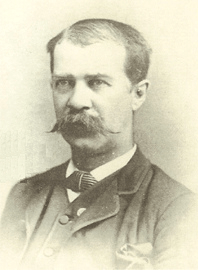
Tonight, on my bike ride home from work, I was visited by the spirit of the forgotten Abolitionist, Anarchist, and Buddhist, Dyer Daniel Lum. According to Tricycle, he was the first American to publicly claim to be a Buddhist, in 1875, which might make him the first “official” Buddhist Anarchist as well. Thoreau published a translation of the Lotus Sutra in 1844 and was himself a proto-anarchist of sorts, but we can’t count him as an “official” member of either camp without stretching the truth a bit too far.
Though he died by his own hand, he was truly a victim of those greatest of diseases, poverty and trauma. Reaching out across time, as any good historical figment of my imagination does, he showed me the horrors of the battlefield, the constant uphill battle against a cruel and uncaring public opinion, the shame and sadness and frustration brought about by the incompatible needs to live and to work for a wage to merely survive. But most of all, he showed me the flame, the bright black flame, which, once kindled, never goes out. The same spirit as Uchiyama Gudo described it, the one who causes us to go forward and ever beyond ourselves, chanting the single-minded heartbeat of a mantra, “freedom, freedom“.
I had encountered his story before during the course of this research, but he did not speak to me then. Or perhaps I did not yet have the ears to hear him. In any case, today he returned, vividly and truely alive, more truly than any of us living today can claim to be. Alive as only one who has entered the Way of the Buddhas can be.
His shade was envoked clearly today because I happened to read his eulogy, written by his life companion Voltarine de Clerye, the night before. I could not hope to outdo her in any way whatsoever, for who knew him better than his best friend and lover. There are two versions of de Cleyre’s eulogy. The first is the shorter, and the second an expanded version found in her collected works.
Comrades:Across the sea I send the echo of a mourning knell. The brightest scholar, the profoundest thinker of the American Revolutionary movement is dead. On Thursday, April 6th, they found him sleeping the last sleep, in a hotel near the Bowery in New York. Utterly without pain he must have passed away, as he had always wished he might – into the painless rest.
Dyer D. Lum was born at Geneva, N.Y., fifty-three years ago. He was descended from an old Puritan family, hence an American as much as it is possible for any Anglo-Saxon to be an American. In early life he was brought up under strict Presbyterian discipline, but piety never seems to have taken any deep root in his sceptical nature. According to one of his own inimitably told stories, such religious sentiment as he had all departed one bright Sunday, when God failed to send a thunderbolt upon him for having played ball, torn his trousers, and uttered an oath on the Lord’s day. And yet in the nobler and better sense of the word Dyer D. Lum was a deeply religious man. He was full of that earnest self-sacrificing devotion to whatever ideal of the future seemed highest to him at any period of his life, and he never stopped at any command of “the inward must,” though it cost him friends, worldly success, or the danger of death itself.
He has frequently said and written that the labor movement of America really began with the Pittsburg riots in 1877; previous to that time, however, he had taken part in the great struggle, now recognised as an economic one, known as the civil war. He fought on the northern side, and so bravely that he jumped from the rank of a volunteer private soldier to that of captain by sheer force of merit. At that time, there is no doubt, he believed himself to be fighting in the good cause. But since he became an economic thinker he has often expressed himself sarcastically as having “gone down there out of patriotism (?) to fight the battle of cheap labor against dear.” After the war he resumed his trade as bookbinder, and began his studies in the economic field. In 1876 he was associated with Wendell Phillips as candidate for lieutenant-governor for Massachusetts on the Greenback ticket. Out of the old nursery of Greenbackism came nearly all of our present radical thought, while few of its original exponents are any longer affiliated with the Greenback program: it was simply the beginning of the Socialistic movement. Mr. Lum was not one to remain long satisfied with the “illogic” of Greenbackism. He was too consistent in mind to accept a mixed authoritarianism and liberty. At first he went over to authoritarianism, and was for a time a State-socialist. Subsequently, however, he became an Anarchist, a contributor to Parsons’ Alarm, and a most cutting critic of State-socialism.
While living in Washington he was appointed on a committee to investigate the conditions of labor, and in the course of that investigation studied the cooperative system of the Mormons (a much abused people here in America). The result was a pamphlet in which he set forth the principles of their labor exchange, disabusing the reader of many false notions in regard to Mormon life. This pamphlet had a wide circulation.
In 1886 he was conducting a bookbindery at Port Jervis, N.Y., when the question of who should keep alive the paper of the imprisoned Parsons arose. Although Lum was an individualist and Parsons Communist, no one else could be found able and willing to continue the work of the doomed editor. Lum did not hesitate. He sold out his business, went to Chicago, put about $1500 into the work, no penny of which he ever received or expected to receive back, ran the gauntlet of police, detectives, and the crowd haters of Anarchy, then very numerous in Chicago, and held the banner aloft as long as he could. During this time he was a constant visitor at the prison, the loved and trusted comrade of those who were about to die, the jealous guardian of their highest honor. Like all who knew those men, he grew to love them all, and never in after years was he able to speak much of them without tears filling his eyes. And yet he counselled them to die. When Parsons asked him his advice as to signing the petition, which he and Lum both knew from sure sources of information would have saved his life, he said, “I cannot advise you.” But when Parsons pressed him, he said, “Die, Parsons.” And the other answered, “I am glad you said it. It is what I wished.” For this he was blamed by some, blamed as “wanting their death.” Yes, he did want their death, as he loved liberty, and honor, and pride, and the future, and their true glory – more than his own life and more than theirs. For those who knew him best knew there was not one moment when he would not have taken his place by their side and walked proudly to the scaffold had the State decreed it.
After the failure of the “Alarm” in Chicago he was enabled, partly through the courtesy of John Most and others, to re-commence its publication in reduced form in New York. But owing to an accumulation of difficulties he could not continue it long. It was a great sorrow to him, for his last promise to Parsons was to do everything to keep the paper alive. From that time on his life was a bitter struggle with poverty whose miseries he endured with shut lips, only his intimate friends knowing how great they were, and even they hardly daring to offer him any help for fear of offending his proud, uncomplaining spirit. This poverty chained his hands, tied his aspirations, compelled him to a forced inaction that wore him out more than the severest active strain. Although of a strong constitution he became a victim of insomnia and burnt up the oil of life without replenishing. – Yet no one would have guessed all this to have met and talked with him, always merry, always full of jokes, always ready to sympathise with the humblest thing that suffered or was glad. At one moment talking Philosophy with the scholars, at the next stroking the sore foot of a dog, or playing hide-and-seek with the children, it was hard to determine what lay deepest beneath those smiling gray eyes that never told aught of the hard personal struggle within.
Of his many pamphlets, articles and poems it may be said all evinced profound thought; but unfortunately were too often in a heavy style that rendered them difficult to the ordinary reader. In fact few students went deeper into psychological depths than he, and his habit of reading the masters, living in the company of books, made language which to most of us is stilted the ordinary channel of his thought. His early studies in Buddhism left a profound impress upon all his future concepts of life, and to the end his ideal of personal attainment was self-obliteration – Nirvana. He had not the slightest use for the Hedonistic doctrines of most of the individualistic school, and often sent the sharp shafts of his wit into the heart of an argument hingeing upon the “pleasure the motive of action” premise.
As to his revolutionary beliefs he always avowed them when there was any reason for so doing. When Berkman shot Frick he was one of those who dared to defend the act. But he did not believe in continually talking about it: He did not believe in telling other people to “do” anything. He never said, “arm yourselves and prepare.” He had his own plans probably; but if he had he trusted to himself, and neither depended upon nor asked aught from others. For the rest he believed in revolution as he believed in cyclones; when the time comes for the cloud to burst it bursts, and so will burst the pent up storm in the people when it can no longer be contained. So he believed, and trusted in the future.
And I who trust in his philosophy trust that in the fire-hued day the spirit of my beloved teacher and friend will burn in the hearts of the strugglers for freedom, till it consumes away all fear, all dependence, all the dross of our “American slavery,” and leaves them erect, proud, free, dauntless as he who has left to them the rich legacy of a life of though and work in their behalf
Voltarine de Cleyre
Philadelphia

The longer version of the eulogy is as follows:
One of the silent martyrs whose graves are trodden to the level by their fellows’ feet, almost before it is seen that they have fallen, completed his martyrdom one year ago to-night.
There are thousands of such, why then commemorate this one?
Let our answer be that in this one we commemorate all the others, and if we have chosen his day and name, it is because his genius, his work, his character was one of those rare gems produced in the great mine of suffering and flashing backward with all its changing lights the hopes, the fears, the gaieties, the griefs, the dreams, the doubts, the loves, the hates, the sum of that which is buried, low down there, in the human mine.
No more modest a man than Dyer D. Lum ever lived; partly, nay mostly, indeed, it was inborn, instinctive; but it was also fostered by his conception of life, which led him to consider self as the veriest of soap-bubbles, a thing to be dispelled by the merest whiff of wind, so to speak; and therefore, personal recognition or personal gain as the most silly, as well as unworthy, of motives. For this reason his works have often gone where his name did not, and thousands of persons have been influenced by his logic and his sentiments who never heard of his personality. Indeed there were some of us who wondered when he died, what certain labor leaders would henceforth do for a cheap scribe to furnish them brains.
I have often heard him quote as his motto, both for organization and for literary effort, the expressive sentence: “Get in your work.” “Let fools take the credit if they want it,” was the implication of his tone, and I shall never forget the delightful smile with which he repeated Charles Mackay’s lines, most singularly transposing the author’s meaning: “Grub little moles——.” He took an especial pleasure in grubbing, and smiling when a streak of sunlight fell on some one else.
I have said that this distinguishing characteristic, so fruitful in results in his later life, was partly instinctive and partly a philosophic conviction. The instinctive side may be best understood by a brief sketch of his ancestry. It is generally complained that the troublesome people who are never satisfied to let society alone, must necessarily be foreigners; at least they can never belong to the same nation as we, the good, the respectable. The easy method of laying everything pestilent to the charge of the foreigner, will not serve a conservative American against Dyer D. Lum. The first of the Lums to set foot in this country was Samuel L., a Scotchman, in the year 1732. They rooted in New England soil, and at the time of the Revolution, Dyer’s great grandfather was a minute-man in the very town, Northampton, where his own corpse was laid a year ago. On the maternal side the Tappan family were also revolutionists, and back of revolutionists Reformationists in the days of Queen Elizabeth, and still back of that, Crusaders. All this would be important enough and indeed even distinguishing, were I relating it by way of “gilding refined gold”; but they acquire meaning the moment we regard them as data for a character. They are fraught with mysterious symbolism, and he himself becomes a symbol of the deep-rooted faith of humanity, when we see that subterranean stream of blood running from Jerusalem through Europe and across the sea to America. It shows how profound is the well-spring of devotion to cause in the human heart; through how many centuries the spirit of rebellion lives. But what, say you, had it to do with his instinctive modesty? This: the devotee of a cause is never the devotee of self.
Now as to his philosophic convictions, it would be easy to deliver a whole lecture upon them; and unfortunately his profoundest work on that subject has not yet been printed. Of course, I can present them but briefly. I must preface that, as you will no doubt observe later on, his beliefs were in his own case a plain testimony to their own correctness. It sounds ridiculous to say that a thing can prove itself; but you will understand me when I explain that he regarded the conscious life of man, which includes, of course, his processes of reasoning and therefore his philosophy, as the merest fragment of him; that this process itself, which we are wont so fondly to consider as setting us higher than the brute, is but an upgrowth of our instincts. Man, the race Man, psychologically as well as bodily, might be likened to a tree, which every year adds small new growths whose bright green verdure opens to the sunlight, while below and supporting them quivers the great dark green mass of the tree, which year after year repeats itself, whispering in its shadows the old whispers of the centuries. The new verdure would represent the conscious life and growth of individuals, budding upward in response to the conditions surrounding them and adding what tiny mite they may to the experience of the race; but beneath and through, and all about them rustle the traditions of the dead—dead as individuals, but living, more potently living than ever, in the great trunk and branches of unconscious, or instinctive life. And as the shape of the newly budding leaf, the shade of its green, the length of its stem, its size, are determined more by the nature of the tree than by surrounding circumstances, so the philosophy of the individual is determined by the instinctive life of the race.
The winter of death comes; the individual withers like the leaf; but the small item of growth that he has added is there, brown and barren though the twig appear. From him new buds will shoot, though its own leaves hereafter rustle in the deep green shadows of unconsciousness. As time passes away useless boughs wither and die, and are stricken utterly from the life of the race; such are the worthless lives, the abnormal growths, which no longer add anything either to the beauty or the service of the whole.
Or, to adopt one of Comrade Lum’s own figures, the useless or brutish elements in man slowly sink down like sediment deposited by the moving current. Now, in a case where we are able to trace a strain of blood as far back as this of his, and further are able to look at the conscious work of the man, and see that the one was the offspring of the other, modified of course by circumstances, we are able to make the seemingly absurd statement that the belief proves its own correctness.
Let me particularize concerning this belief. First he was in all his writings the advocate of resistance, the champion of rebellion. But long before he had reduced the matter to a syllogism, he was a resistant in fact. What else could you expect from the Crusader, the Reformationist, the Revolutionist? It might be said by the people who believe in the supreme influence of circumstances, that it was his social environment which made him such—that given the ideal social order and he would have been as mild a pacificator as Jesus: which is equivalent to saying that given the outward circumstances and an ear of wheat will grow from a seed corn.
Lum was the resistant, the man of action; the man who while scarcely more than a boy, enlisted as a volunteer in the 125th New York infantry to fight a cause he then deemed just; who being taken prisoner, twice effected his escape; who sick of the inaction of superiors, while a third-time prisoner waiting to be exchanged, took his exchange in his own hands, at the risk of death for desertion, and within a month re-enlisted in the cavalry, where by sheer force of daring he rose from private to captain; the man who smashed the idol of the Greenback movement, sooner than let him betray its voters, reckless himself of the rebound of hate from the politicians; the man who cast all business prospects and journalistic hopes aside as so much chaff, when he picked up the fallen banner of the fight in Chicago, by editing the paper of Albert Parsons, then in prison and doomed to die; the man who could say to his well-beloved friend, when that friend asked him whether he should petition Governor Oglesby for his life, knowing that that petition would be granted, the man who, under these circumstances could say: “Die, Parsons”; the man who poor, defeated, dirty, ragged, hungry, could proudly refuse the proffered hand of the then king of the labor movement, that king who had kept his kingdom by repudiating the martyrs of Chicago from the limitless height of one soul over another, answer “there’s blood on it, Powderly”; the man who faced a public audience to defend the shooting of Frick by Alexander Berkman, a few days after the occurrence, because he felt that when another has done a thing which you approve as leading in the direction of your own aspirations, it is your duty to share the effects of the counterblast his action may have provoked; the man who seized the unknown Monster, Death, with a smile on his lips—all of this man was germinating in the child of the pious home who even when a mere boy had dared Jehovah.
Having “weighed Him, tried Him, found Him naught,” he threw the Jewish God and cosmogony overboard with as much equanimity as he would have eaten his dinner, and set about finding a more reasonable explanation of phenomena. In this, as in all other matters, the man of action has a certain advantage over a pure theorist, which is this: he plunges immediately into the conflict, he throws the gauntlet, rashly sometimes, but boldly; he settles the question at once; if there is any suffering attached to the attempt, he suffers once and has done with it; while the theorist, the fellow who walks tiptoe round the edge of the battle-field, dies a hundred times and still suffers on.
My own conversion from orthodoxy to freethought was of this latter sort. I never dared God; I always tried to propitiate him with prayers and tears even while I was doubting his existence; I suffered hell a thousand times while I was wondering where it was located. But my teacher winked at the heavens, braved hell, and then tossed the whole affair aside with a joke.
Nevertheless, he did not, as nearly all of our modern image-breakers have done, deny all religions in their entirety, because he had run a lance through a stuffed Mumbo-Jumbo. Indeed, the spirit of devotion to something greater than Self, which will be found as the kernel of every religion, was so thoroughly in him, or indeed was he himself that whether he fancied himself willing it or not, his inclinations directed all his conscious efforts to read the riddle of life into the channel of Buddhism. I do not know whether he ever accepted its peculiarly fanciful side or not; but if he did, it was early corrected by a no less characteristic trait, also an inheritance of the Tappan family, that of critical analysis. An omnivorous reader, he was always abreast of the times in matters of scientific discovery; and his inexorable logic would never have permitted him to retain a creed which necessitated any doctoring of facts; he rather doctored the creed to fit the facts and thus evolved a species of modern Buddhism which he called “Evolutional Ethics,” whose principles may be briefly stated as follows:
Man is the continuation of the process of evolution up to date. He is thus united to all other products of evolution, and is governed by the same laws. The two factors which determine form in the organic world are adaptation and inheritance; and since evolution is no less a matter of psychology than physiology, the soul of man as well as the soul of animals and plants, must be moulded by these factors. That inheritance tends to crystallize existing forms, while adaptation, or the influence of environment, ever tends to modification of forms, whether physical or intellectual. That mind as much as body is unconscious, so far as there is perfect adaptation to surroundings; and that only when inharmony of the organism with the environment as the result of change in the latter, arises, can there be consciousness. That this consciousness is a state of pain, more or less sharply defined; and will continue to increase in intensity until the necessary adaptation is accomplished, when as a result a feeling of satisfaction or pleasure will ensue, gradually sinking into the blissful unconsciousness of perfect harmony. That progress thus demands this stepping constantly up the rough stairway of pain; and that not even one step is passed until moistened by the blood of many generations. That the path up the mountain side is not laid out by us, but for us, and that we must travel there whether it pleases us or not. That the chances are it will not please us; that our whole lives, in so far as they are conscious, will probably be one record of never achieved struggle; and that rest will come only when we descend to the unconsciousness of Death.
Thus he was a pessimist of the darkest hue; and yet he never wasted a moment’s regret on the facts. He watched this passing spectre man, gliding among the whirling dance of atoms, contemplated his final extinction with composure, sneered at metaphysicians while he himself was buried in metaphysics, and cracked jokes either at his own expense or somebody else’s.
The result of all this speculation was the conclusion that man, being a social animal, must adapt himself to social ends (not determined by him but for him—unconsciously); that therefore the one who sets himself and his egotistic desires against the social ideal is the supreme traitor. He had a peculiar power of expressing volumes in an epithet; and the epithet he gave to the Egoist was “Dung-Beetle.” For the sake of those who may not be familiar with the insect referred to, I may explain that a dung-beetle is a sort of bug that exhibits its instincts by rolling a ball of dung, and who sometimes appears to meditate when he rolls over the ball that the universe has turned bottom up—because he has.
Now, it is well known that the greater part of the reform camp—particularly the Anarchistic camp—is made up of Dung-Beetles, I mean of Egoists; people who declare that the desire for pleasure is the motive of action, who think a great deal of their egos and don’t care a rap for society. The result was they sharpened their pencils and wrote scathing editorials denouncing him. To which he answered never a word. First, because he didn’t consider himself worth fighting about; and second, if he had, he was altogether too good a general to do it. His opponents were a disputatious sort, who liked nothing better than argument; he knew what his enemy wanted and didn’t do it.
But when a question worth discussing arose, then woe to those who had courted the rapier of his wit, or challenged to duel with the diamond-tipped dagger of his sarcasm. He could answer columns with a paragraph.
I do not know whether this philosophy of his had crystallized in his own mind before he became an Anarchist or not. I believe, however, it had not; I think it grew along with his other conceptions, being broadened and corrected, and in turn broadening and correcting his thought in other channels. But at any rate, fully developed or not, it certainly influenced his conclusions on economic subjects greatly. True to his instincts he was always at the front of battle, and when the war closed his first move was to attach himself to the Greenback party, the first widespread expression of organized protest against monopoly of the means of production in America. He still had faith in the saving grace of politics, and was active enough in the agitation to be nominated for Lieut. Governor of Massachusetts with Wendell Phillips for Governor. The fight, which besides being a demand for fiat money, embodied a short-hour movement, took on a national character; and Dyer D. Lum with five others, including Albert R. Parsons, was appointed on a committee to push the matter before Congress. This was in 1880. Six years later, time and the tide had driven both of them into the great current of Socialism, and final repudiation of politics as a means of attaining Socialistic ideals. And here came in the philosophy of the unconscious. The socialization of industry was the next step up the mountain side, not because men wished or planned it; but the pressure of surroundings made it the only possible move; but on the other hand the reactionary, system-building Socialism advocated by the great master Marx, and all his train of little repeaters, was seen to be at variance with a no less marked feature of the evolving social ideal, viz., elasticity, mobility, constantly increasing differentiation; which is only possible when units of society are left free to adapt themselves to the slightest changes, unforced by the opinions of other people who know nothing of the matters in question, but who, being in the majority (for where is ignorance not in the majority?) could suppress the free movements of the minority by enacting their ignorance into laws.
Thus it will be seen that he looked forward to free Socialism as the industrial ideal; the requirements of that ideal are laid down in his “Economics of Anarchy.”
A few of his caustic sentences may here be quoted:
“The Statist assumes that rights increase in some metaphysical manner, and become incarnate in half the whole plus one.”
“Politics discovers wisdom by taking a general poll of ignorance.”
“Every appeal to legislation to do aught but undo is as futile as sending a flag of truce to the enemy for munitions of war.”
“When Caesar conquered Greece, he subjugated Olympus, and the Gods now measure tape behind counters with Christian decorum.”
Lum had faith in humankind. He always trusted the people; the people that maligned him, the people that injured him, the people that killed him. When I asked him once why he did not get angry at an individual who industriously circulated lies about him, he answered with a twinkling laugh, “For the same reason that I don’t kick the house-cat.” And yet he had an abiding faith in that man, and other similar men, to work out the judgments of the human race, undisturbed by the fact that they let their only honest leaders die in garrets.
And underneath the speculative philosopher who confused you with long words; underneath the cold logician who mercilessly scouted at sentiment; underneath the pessimistic poet that sent the mournful cry of the whip-poor-will echoing through the widowed chambers of the heart, that hung and sung over the festival walls of Life the wreaths and dirges of Death; underneath the gay joker who delighted to play tricks on politicians, police and detectives; was the man who took the children on his knees and told them stories while the night was falling, the man who gave up a share of his own meagre meals to save five blind kittens from drowning; the man who lent his arm to a drunken washerwoman whom he did not know, and carried her basket for her, that she might not be arrested and locked up; the man who gathered four-leafed clovers and sent them to his friends, wishing them “all the luck which superstition attached to them”; the man whose heart was beating with the great common heart, who was one with the simplest and the poorest.
Lum held that evolutional ethics, or Anarchist ethics, in fact, must take account of both the altruistic and egoistic impulses; that while determining causes will ever lie in the mysterious realm of the unconscious life, consciousness may discern the trend of development and throw in its quota of influence for or against. That in its endeavor to comprehend the trend of development, it should take fair account of ancient truths, however enveloped in superstitious husks; should aim to extract the virtue even in the much mistaken altruistic doctrines of vicarious atonement and personal abasement; and while emphasizing the negation of human rulership as destructive of the possibilities of true growth, at the same time to acknowledge the vain conceit of self as anything more than a temporary grouping of instinct developed in beast, in plant, in man; to acknowledge the individual creature as a sort of mirrored reflection of the cosmos, constantly shifting, now scintillant, now vague and evanescent, now gone forever as Death breaks the mirror.
The notion of immortality which grows from such a conception of self is purged of the old vain conceit. It has been most beautifully voiced in George Eliot’s “Choir Invisible,” Mr. Lum’s favorite poem; and in the lines is expressed the last great limitless shadow which engulfs even this immortality, the blind, tremendous darkness which lies at the end of all, the sense of the invincibility of which must have lain upon our teacher’s soul when after the last searching, inexplicable, farewell look into a friend’s eyes he went out into the April night and took his last walk in the roar of the great city—he who should soon be so silent!
Most of his comrades were surprised. They said: “I never thought Dyer D. Lum would go alone.” But I who know how often and how wearily he said “What’s the use,” am sure that that mocking question lay at his heart, and paralyzed the will to do.
Like Olive Schreiner’s stars in the African Farm, the soul about to depart sees the earth so coldly—all the ages are as one night—and like them he watches little helpless creatures of the earth come out and crawl awhile upon its skin, then go back beneath it, and it does not matter—nothing matters.
Voltarine de Cleyre was herself influenced by Lum’s dharma, and in occasion wrote favorably of Buddhism. In one instance, she translated an article from a French journal, simply titled “Buddhism”, which was itself a tale of Buddhist ethics of compassion in conflicts with the demand of the Juridical and Carceral ethics of the State. In the article, a supposed Buddhist Chinese cucumber merchant in Manchuria lies in his deathbed but refuses to identify and denounce a Russian Cossack soldier who shot him.
Next, a couple of extended quotations from secondary sources. Here, in his article “Ideology, Strategy, Organization”, Frank H. Brooks describes Lum’s spiritual journey:
Lum’s post-war involvement with spiritualism, while less typical of both Americans generally and anarchists specifically, was nevertheless important in his radicalization. Indeed, the “new labor history” insists that religion be taken seriously in considering working-class culture. For radicals, religion was sometimes an obstacle and sometimes an avenue to radicalism. For Lum, it was something of both. Raised as an orthodox Presbyterian, Lum became a skeptic in childhood, when he discovered that God did not strike him down for yelling “Damn!” while playing on a Sunday. Like many others in western New York in mid- century, Lum turned to spiritualism for direct, individual, and “scientific” knowledge of the afterlife. For at least five years after the Civil War, he wrote on science and evolution for major spiritualist papers such as Banner of Light. In 1873, disillusioned with the gullibility and unscientific approach of many mediums and spiritualists, he published a denunciation of the movement, The “Spiritual” Delusion. For the next few years, the Free Religious Association’s Index was the major outlet for his skeptical inquiries into organized religion. Lum’s skepticism culminated in 1875, when he turned to Buddhism, which he saw as anti-institutional, antidogmatic, egalitarian and humanistic. In a sense, he had whittled away religion to its psychological core, devotion to something outside self. Having accomplished that, he wrote virtually nothing about religion for the rest of his life. Nevertheless, the humanism of Buddha’s writings influenced Lum’s socialism and his theory of history. The Buddhist concept of nirvana, with its indifference to death and the individual soul, provided a quasi-religious sanction for Lum’s occasionally reckless devotion to revolution. Eventually, Lum’s cold, revolutionary selflessness led him to urge his Haymarket comrades’ martyrdom and ultimately to take his own life when the prospects for revolution seemed dim
And here, in Thomas A. Tweed’s, The American Encounter With Buddhism, I have excerpted a couple of paragraphs dealing with Lum’s Buddhist-Anarchist identity. Tweed’s treatment of Lum’s Dharma is colored with the somewhat condescending twinge characteristic of some scholars of Buddhist modernism, and so I would take it with a grain of salt. He also inaccurately describes de Cleyre as Lum’s “niece”, which I have corrected in square brackets, replacing it with [partner]. Although it is certainly wise to critique the 19th Century Euro-American understanding of Buddhism, Tweed’s editorializing does little to capture the drama and passionate dynamism of Lum’s life and faith.
“Yet no one was more sympathetic than Dyer Daniel Lurn (1839-93), the religious radical and political anarchist. In fact, Lum probably was the first American of European descent to publicly proclaim allegiance to Buddhism. Although Lum’s article on Buddhism was published in the Index during this early period, in most ways he belonged to the next. His response to Buddhism followed the pattern that would be set in the late-Victorian period. He found a celebration of the “infinite perfectibility of man’s nature” at the bottom of Buddhism; and this optimistic foundation, he asserted, supported Buddhism’s lofty moral code. Like many other American participants in the discourse, Lum praised Buddha’s ethics and reform impulse, and he lauded the tradition’s tolerant spirit. He even suggested that Buddhism could pass the “test of history”: it had beneficial cultural influences in Asia. Yet rather than struggle to reconcile Buddhism’s reported rejection of a personal God and an immortal soul with Victorian values—as Johnson and other mid-Victorian radicals with sympathy for Buddhism had done—he celebrated its negation of these. This, Lum announced, rendered Buddhism more compatible with “Western science.” Like many late-Victorian American advocates, Lurn was attracted to Buddhism by its reported compatibility with science and tolerance. And, although he was willing to abandon the belief in a personal creator and substantial self, he still felt compelled to emphasize Buddhism’s harmony with Victorian self-reliance, optimism, and activism.” (p. 23)
“Lum’s writings on Buddhism offer an especially revealing example of the rationalist type. In his important essay, “Buddhism Notwithstanding,” he had attempted to “interpret Buddha from a Buddhist standpoint.” In that piece, which was published in the magazine associated with the “scientific theist” branch of the Free Religious Association, Lurn presented Buddhism as “the religion of reason.” His interpretation of Buddhism was colored by commitments characteristic of the rationalist type: he championed the authority of the individual, focused on ethics, promoted tolerance, and embraced “modern science.” For Lum, biological and moral evolution were intertwined, and the path to the moral perfection of humanity, and so
ethics, was found in the laws of the natural world. All ethical systems, and all religions too, must be judged by, and be compatible with, the laws uncovered by modern geology and biology. By this criterion, Lurn argued, Buddhism is superior to Christianity and other traditions. Buddhists are not asked to “sacrifice reason” by believing in notions that are contradicted by modern science-such as the belief in a supernatural being and an immortal soul. The doctrine of the moral law of cause and effect (karma), for instance, provides the basis for a religious view which is in perfect harmony with biological evolution, natural selection, and heredity. In its doctrine of karma Buddhism is able to account for the “moral government
of the world, without a personal governor.”
“The only published pieces that focus exclusively on Buddhism — “Buddhism Notwithstanding” (1875) and “Nirvana” (1877) — appeared mid-career; but Lum continued to refer positively to the tradition in later
philosophical articles. And he seems to have continued his allegiance to the tradition until his death. In a posthumous tribute, his [partner], who knew him better than anyone, suggested that Lurn had “directed all his conscious efforts to read the riddle of life into the channel of Buddhism.” Whether a Westernized Theravada Buddhism or an idiosyncratic evolutionist-positivist philosophy formed the “channel” through which his beliefs and values flowed, it seems clear that Buddhism was an important
part of his worldview.” (p. 66)
“Lum also hoped for a “social war,” and he provides perhaps the clearest example of political and economic dissent. He played a role in organizing the bookbinders into a union during the 1870s-the period in which he embraced Buddhism; and as the years passed Lum turned his attention more and more toward political, social, and economic questions. He argued publicly against the anti-Oriental sentiment that raged among
workers during the 1870s and 1880s.” (p.84)
In the next passage Tweed calls attention to the specific interpretation of Buddhism which was prevalent in the mid 19th century: that of the Pessimist philosopher Schopenhauer, who constructed his thought in response to Hegel, basing it instead on a rather literal reading of translations from the Theravadin Pali Canon initiated by Burnouf in 1844. Much of this work continued by the anti-colonial modernist movement in Sri Lanka, a collaboration between Anagarika Dharmapala and the Theosophists Olcott and Blavatsky. Burnouf and Schopenhauer’s Buddhism had been a hit in Europe, so, they reasoned, why not double down on a winning formula? Their shared project was to reinterpret Buddhism as a strictly scientific and rational religion, in contrast to the old Theistic Absolutisms of Europe, while stripping Buddhism of its supposedly irrational and degenerate features. These “degenerate” features, however, included almost all of the Mahayana tradition. The Western Orientalist view of Buddhism at this time was almost entirely textual, a bias which is only now beginning to erode as diverse types of and communities of Buddhist practice continue to enter the Western mainstream culture. The Anarchist Alexandra David-Neel, who originally travelled to India to study the “new” Theravada, upon contact with Tibetan Buddhists, quickly outgrew the limitations of the dry rationality offered by the modernist movement and came to embrace instead the compassionate, active, non-renunciative “rational mysticism” of the Tantric/Dzogchen tradition. The American Transcendentalists also provided another vision of Buddhism in the form of Thoreau’s translations from the Lotus Sutra. Nevertheless, the prevailing idea of Buddhism in the West was Schopenhauer’s rational pessimism. Anarchists Pierre Joseph Proudhon and Mikhail Bakunin were both aware of (and somewhat perplexed by) the incomplete version of Buddhism which was available to them: simultaneously atheistic and theistic, normative and subversive, nihilistic and substantialist. In a later article I plan to get into the details of the unwitting convergence in thought between Proudhon and Tiantai interpretations of the Lotus Sutra in particular… Anyways, Tweed:
“Even those who expressed appreciation for Schopenhauer’s thought also affirmed Victorian convictions and attitudes. As I have indicated, Wilson clearly did so. Although there seems to have been a limited acceptance of passivity and pessimism in his life and work, so did Lum. The rationalist Lum was drawn to Schopenhauer’s thought and lured by a humanistic mysticism. His [partner] described him as “a pessimist of the darkest hue” because he believed, with most Buddhists, that consciousness necessarily brings suffering. Lum was suicidal; he clearly did not have the incurably optimistic temperament of Whitman. He did not sacralize the ordinary or embrace all that is. In fact, Lum referred to his own perspective at times as “Schopenhauerismus” or “philosophic pessimism.” Further, if we looked only at the passages in his writings that affirm no-self and look forward to the “absolute rest” of nirvana, it would be easy to conclude that Lum’s Buddhism was both pessimistic and passive. Yet Lum also clearly expressed a commitment to optimism and activism. He was sustained in his continuing efforts at reform, for example, by a lofty view of humanity. Lum possessed that deep faith in the natural capacities of persons that is characteristic of most libertarians and anarchists and that was shared by most participants in Victorian culture. He called for the development of increasing freedom in all areas of human life because he believed that this would lead inevitably to the moral perfection of the race. The application of “the Law of Equal Freedom” to religion,
politics, society, and economy would lead to “the normal evolution of sympathetic natures.” It would stimulate the development of “an emancipated people living in the mutual bonds of peace and fraternity.” Further, in his interpretation of Buddhism, he emphasized its compatibility with activism. The Buddha was a social and religious reformer who expressed egalitarian principles in his acceptance of women into the religious order and in his challenge of the Indian caste system. Applying pragmatic criteria and leaning on the authority of mid-Victorian interpretations, Lum described the “markedly beneficial” social effects of Buddhism. He stressed Buddhism’s fundamental optimism about humans and argued that its cardinal idea of the perfectibility of man” was the basis for a personal and social ethic. It had led, for example, to a tolerant spirit and a low crime rate. Buddhism could pass “the test of history.” So even when American advocates spoke of the pervasiveness of suffering or welcomed mystical or aesthetic interpretations of Buddhism, they seemed to agree with their contemporary critics and mid-Victorian predecessors.” (p. 153)
I’d like nothing better to give our comrade Dyer D. Lum the last word. I was able to find his two “Nirvana” poems in a digitized copy of the Radical Review, August 1877. I think that they are a lot better than Tweed would like to admit. Certainly characteristic of Pessimistic early Western Buddhism, but with a distinct and fiery anarchist hopefulness and love of freedom running throughout. Pay particular attention
NIRVANA.
Tossed on the shoreless sea of life,
’Mid surging waves of pain and strife,
Where mountain high the billows roll,
The wearied eye discerns no land,
Discerns no outstretched helping hand,
That brings not death unto the soul.
All life is struggle, life is pain,
E’en life renewed is strife again
On other seas that give no rest ;
Yet, held by Buddha’s four-fold way,
We calmly watch the billows play,
Though tossed upon their seething crest.
No more we plead with tearful eyes,
Or craven fears, the brazen skies,
But laugh to scorn their boasted powers ;
Though demons curs’d and gods divine
Against us all their arts combine,
We heed them not,—the battle’s ours !
Let weaklings bend the knee and fall
Prostrate in worship to the All;
The soul of man, self-centred, free,
No goal can know not infinite,
Must claim o’er all a victor’s right,
Then fade into Infinity.
THE MODERN NIRVANA.
ARE we immortal? Do we live for ever,
While round and round the countless cycles run?
Is there no goal that we by high endeavor
May reach to find some setting of life’s sun?
Why cherish life, if souls of greatest merit
For conflict here must conflict still inherit,
And find the path which leads from sense to spirit
Leading to deeper anguish, pain, and strife?
For Life e’er sees our bonds more firmly riven,
E’er sees our souls in denser darkness driven ;
For, though it be within the walls of heaven,
Eternal struggle. is the doom of life.
Why is the path by which mankind has risen
Traced in the life-blood of its martyrs slain?
Must life to souls refined e’er prove a prison
Till Death can loose the captive from his chain?
Is Life then but a larger convict station,
And sorrow part of mankind’s condemnation,
Where Death alone brings final reparation,
And wrong undone in other worlds than this?
Blind leaders of the blind! Life’s full fruition
Lies not in self; no soul of high ambition
E’er listens to your warnings of perdition,
Nor yet your selfish bribes of future bliss.
Although in ceaseless file men pass Death’s portal,
With all his art Death ne’er can Man efface ;
For, like the mountain brooklet, every mortal
Swells the majestic stream—the Human Race!
The martyr’s zeal for selfhood’s immolation,
The dying hero’s shout of exultation,
The exile’s strain of mournful lamentation,
Survives the evanescent glow of fame.
And ours the wealth of all the countless ages,
Increased by deeds unknown to history’s pages ;
For us the wealth of prophets, heroes, sages,
To use for Man—his honor or his shame.
Heirs of the past! All thought and aspiration,
Like troubled ghosts, still haunt the human soul,
Thrilling with their touch each heart’s pulsation
With mystic impulse toward a common goal—
Humanity !—within whose fond embraces
In unison are fused earth’s warring races.
Be ours the task to leave still deeper traces,
Forgetting self that Man alone may gain ;
That through our lives we leave the standard higher,
And touch men’s souls as with celestial fire,
Until all men with one accord aspire
The limits of man’s stature to attain.
Sources
Baumann, Martin. “Buddhism in the West: Phases, Orders and the Creation of an Integrative Buddhism” Internationales Aisenform, Vol 27 (1996), No. 3-4, p. 345-362. Accessed from: https://d-nb.info/1218975598/34
Brooks, Frank. “Ideology, Strategy, and Organization: Dyer Lum and the American Anarchist Movement” Labor History, Volume 34, Number 1, Winter 1993, pp. 57–83. Accessed from: https://theanarchistlibrary.org/library/frank-h-brooks-ideology-strategy-and-organization
de Cleyre, Voltarine. “Dyer D. Lum” Originally published in Freedom, June 1893. Republished in KSL: Bulletin of the Kate Sharpley Library No. 62, May 2010. Accessed from: https://theanarchistlibrary.org/library/voltairine-de-cleyre-dyer-d-lum
de Cleyre, Voltarine (trans.). “Buddhism” Fibre and Fabric 36, no. 935 (January 31, 1903): 300. Accessed from: https://www.libertarian-labyrinth.org/the-sex-question/buddhism-translated-by-voltairine-de-cleyre-1903/
Lum, Dyer D. “Nirvana” and “The Modern Nirvana,” The Radical Review, Aug. 1877, 260–262. Accessed from: https://archive.org/details/sim_radical-review_1877-08_1_2
Wilson, Jeff. “Moments in American Buddhism” Tricycle. Fall 2001. Accessed from: https://tricycle.org/magazine/moments-american-buddhism/
 No Selves, No Masters