
I have been doing a deep dive on Mikhail Bakunin‘s philosophy. The Political Philosophy of Mikhail Bakunin, by G.P. Maximoff is an excellent resource. Most of Bakunin’s theoretical writings are scattered throughout various articles, letters, manifestoes and half-finished manuscripts, and as a result his theoretical contributions to anarchism are often overlooked. Maximoff’s book is a sort of “Bakunin mixtape” which collects and organizes all of his theoretical writings into a relatively coherent narrative.
I wanted to share this excerpt because of its perennially relevant clarity: in light of the escalating “forever war” waged by the United States, Israel and their allies, and in particular the indiscriminate assault on the Iranian people this month, I wanted to say something. But Bakunin put it much better than I could hope to do.
I have juxtaposed Bakunin’s words with photographs of the war (source: CNN)

A boy tries to climb on an unexploded missile after it fell in an open field in Qamishli, Syria, on Wednesday, March 4. Baderkhan Ahmad/AP
Every State, whether it is of a federative or a non-federative character, must seek, under the penalty of utter ruin, to become the most powerful of States. It has to devour others in order not to be devoured in turn, to conquer in order not to be conquered, to enslave in order not to be enslaved—for two similar and at the same time alien powers, cannot co-exist without destroying each other.
The Universal Solidarity of Humanity Disrupted by the State.

The State then is the most flagrant negation, the most cynical and complete negation of humanity. It rends apart the universal solidarity of all men upon earth, and it unites some of them only in order to ‘destroy, conquer, and enslave all the rest. It takes under its protection only its own citizens, and it recognizes human right, humanity, and civilization only within the confines of its own boundaries. And since it does not recognize any right outside of its own confines, it quite logically arrogates to itself the right to treat with the most ferocious inhumanity all the foreign populations whom it can pillage, exterminate, or subordinate to its will. If it displays generosity or humanity toward them, it does it in no case out of any sense of duty: and that is because it has no duty but to itself, and toward those of its members who formed it by an act of free agreement, who continue constituting it on the same free basis, or, as it happens in the long run, have become its subjects.
Since international law does not exist, and since it never can exist in a serious and real manner without undermining the very foundations of the principle of absolute State sovereignty, the State cannot have any duties toward foreign populations. If then it treats humanely a conquered people, if it does not go to the full length in pillaging and exterminating it, and does not reduce it to the last degree of slavery, it does so perhaps because of considerations of political expediency and prudence, or even because of pure magnanimity, but never because of duty—for it has an absolute right to dispose of them in any way it deems fit.
Patriotism Runs Counter to Ordinary Human Morality.

US President Donald Trump salutes during a dignified transfer at Dover Air Force Base in Delaware on Saturday, March 7. Six US Army Reserve soldiers were killed March 1 in an Iranian drone strike in Kuwait.Julia Demaree Nikhinson/AP
This flagrant negation of humanity, which constitutes the very essence of the State, is from the point of view of the latter the supreme duty and the greatest virtue: it is called patriotism and it constitutes the transcendent morality of the State. We call it the transcendent morality because ordinarily it transcends the level of human morality and justice, whether private or common, and thereby it often sets itself in sharp contradiction to them. Thus, for instance, to offend, oppress, rob, plunder, assassinate, or enslave ones fellow-man is, to the ordinary morality of man, to commit a serious crime.
In public life, on the contrary, from the point of view of patriotism, when it is done for the greater glory of the State in order to conserve or to enlarge its power, all that becomes a duty and a virtue. And this duty, this virtue, are obligatory upon every patriotic citizen. Everyone is expected to discharge those duties not only in respect to strangers but in respect to his fellow citizens, members and subjects of the same State, whenever the welfare of the State demands it from him.
The Supreme Law of the State.

Smoke billows above the compound of Iran’s supreme leader on February 28. Airbus
The supreme law of the State is self-preservation at any cost. And since all States, ever since they came to exist upon the earth, have been condemned to perpetual struggle—a struggle against their own populations, whom they oppress and ruin, a struggle against all foreign States, every one of which can be strong only if the others are weak—and since the States cannot hold their own in this struggle unless they constantly keep on augmenting their power against their own subjects as well as against the neighbor States—it follows that the supreme law of the State is the augmentation of its power to the detriment of internal liberty and external justice.
The State Aims to Take the Place of Humanity.

Government supporters in Tehran gather in mourning after state TV officially announced the death of Khamenei. Vahid Salemi/AP
Such is in its stark reality the sole morality, the sole aim of the State. It worships God himself only because he is its own exclusive God, the sanction of its power and of that which it calls its right, that is, the right to exist at any cost and always to expand at the cost of other States. Whatever serves to promote this end is worth while, legitimate, and virtuous. Whatever harms it is criminal. The morality of the State then is the reversal of human justice and human morality.
This transcendent, superhuman, and therefore anti-human morality of States is not only the result of the corruption of men who are charged with carrying on State functions. One might say with greater right that corruption of men is the natural and necessary sequel of the State institution. This morality is only the development of the fundamental principle of the State, the inevitable expression of its inherent necessity. The State is nothing else but the negation of humanity; it is a limited collectivity which aims to take the place of humanity and which wants to impose itself upon the latter as a supreme goal, while everything else is to submit and minister to it.
The Idea of Humanity, Absent in Ancient Times, Has Become a Power in Our Present Life.

Rescue workers and residents search through the rubble of an elementary school in Minab, Iran, on February 28. Iranian officials say at least 168 young students were killed when US-Israeli airstrikes hit the school, which sits about 200 feet from an Iranian military base. CNN has not been able to independently verify who is responsible for the strike. When asked about the strike, a US Central Command spokesperson said, “we are aware of reports … and are looking into them.” Abbas Zakeri/Mehr News Agency/AP *Since CNN published the killers were determined to be the USA*
That was natural and easily understood in ancient times when the very idea of humanity was unknown, and when every people worshiped its exclusively national gods, who gave it the right of life and death over all other nations. Human right existed only in relation to the citizens of the State. Whatever remained outside of the State was doomed to pillage, massacre, and slavery.
Now things have changed. The idea of humanity becomes more and more of a power in the civilized world, and, owing to the expansion and increasing speed of means of communication, and also owing to the influence, still more material than moral, of civilization upon barbarous peoples, this idea of humanity begins to take hold even of the minds of uncivilized nations. This idea is the invisible power of our century, with which the present powers—the States—must reckon. They cannot submit to it of their own free will because such submission on their part would be equivalent to suicide, since the triumph of humanity can be realized only through the destruction of the States. But the States can no longer deny this idea nor openly rebel against it, for having now grown too strong, it may finally destroy them.
The State Has to Recognize in Its Own Hypocritical Manner the Powerful Sentiment of Humanity.

Protesters shout slogans as they carry portraits of Khamenei and wave Iranian flags near the US embassy in Baghdad on February 28. Ahmad Al-Rubaye/AFP/Getty Images
In the face of this painful alternative there remains only one way out: and that is hypocrisy. The States pay their outward respects to this idea of humanity; they speak and apparently act only in the name of it, but they violate it every day. This, however, should not be held against the States. They cannot act otherwise, their position having become such that they can hold their own only by lying. Diplomacy has no other mission.
Therefore what do we see? Every time a State wants to declare war upon another State, it starts off by launching a manifesto addressed not only to its own subjects but to the whole world. In this manifesto it declares that right and justice are on its side, and it endeavors to prove that it is actuated only by love of peace and humanity and that, imbued with generous and peaceful sentiments, it suffered for a long time in silence until the mounting iniquity of its enemy forced it to bare its sword. At the same time it vows that, disdainful of all material conquest and not seeking any increase in territory, it will put an end to this war as soon as justice is re-established. And its antagonist answers with a similar manifesto, in which naturally right, justice, humanity, and all the generous sentiments are to be found respectively on its side.
Those mutually opposed manifestoes are written with the same eloquence, they breathe the same virtuous indignation, and one is just as sincere as the other; that is to say, both of them are equally brazen in their lies, and it is only fools who are deceived by them. Sensible persons, all those who have had some political experience, do not even take the trouble of reading such manifestoes. On the contrary, they seek to uncover the interests driving both adversaries into this war, and to weigh the respective power of each of them in order to guess the outcome of the struggle. Which only goes to prove that moral issues are,not at stake in such wars.
Perpetual War Is the Price of the State’s Existence.

US Secretary of State Marco Rubio speaks to the media on Capitol Hill on Monday, the day congressional leaders were briefed on the situation in Iran. Rubio said the “the hardest hits are yet to come”while noting that the Trump administration believes that the objectives for its operation against Iran “can be achieved without ground forces.” Ken Cedeno/Reuters
The rights of peoples, as well as the treaties regulating the relations of States, lack any moral sanction. In every definite historic epoch they are the material expression of the equilibrium resulting from the mutual antagonism of States. So long as States exist, there will be no peace. There will be only more or less prolonged respites, armistices concluded by the perpetually belligerent States; but as soon as a State feels sufficiently strong to destroy this equilibrium to its advantage, it will never fail to do so. The history of humanity fully bears out this point.
Crimes Are the Moral Climate of the States.
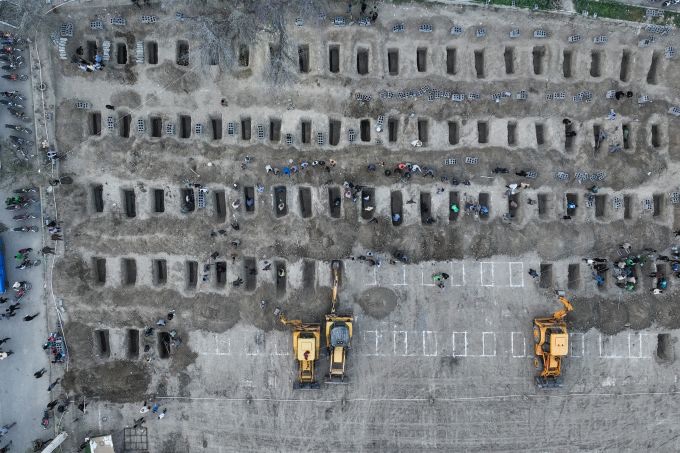
In this aerial photo released by the Iranian Press Center, mourners dig graves during a funeral in Minab, Iran, on Tuesday, March 3. Iranian officials sayat least 168 young students were killed February 28 when US-Israeli airstrikes hit the Shajaba Tayyiba Girls’ elementary school in Minab. The school sits about 200 feet from an Iranian military base. The United States military was likely responsible for the strike, according to CNN and expert analysis of evidence. Iranian Press Center/AFP/Getty Images
This explains to us why ever since history began, that is, ever since States came into existence, the political world has always been and still continues to be the stage for high knavery and unsurpassed brigandage—brigandage and knavery which are held in high honor, since they arc ordained by patriotism, transcendent morality, and by the supreme interest of the State. This explains to us why all the history of ancient and modern States is nothing more than a series of revolting crimes; why present and past kings and ministers of all times and of all countries—statesmen, diplomats, bureaucrats, and warriors—if judged from the point of view of simple morality and human justice, deserve a thousand times the gallows or penal servitude.
For there is no terror, cruelty, sacrilege, perjury, imposture, infamous transaction, cynical theft, brazen robbery, or foul treason which has not been committed and all are still being committed daily by representatives of the State, with no other excuse than this elastic, at times so convenient and terrible phrase reason of State. A terrible phrase indeed! For it has corrupted and dishonored more people in official circles and in the governing classes of society than Christianity itself. As soon as it is uttered everything becomes silent and drops out of sight: honesty, honor, justice, right, pity itself vanishes and with it logic and sound sense; black becomes white and white becomes black, the horrible becomes humane, and the most dastardly felonies and most atrocious crimes become meritorious acts.

Vapor trails remain in the sky above Tel Aviv, Israel, after Israel intercepted missiles launched from Iran on Friday, March 6. Dylan Martinez/Reuters
 No Selves, No Masters