I have been thinking about the idea of “taking refuge”. These days we all need some kind of refuge or another. Those of us who have a little ought to offer more. We should expand the meaning of refuge: Refuge from poverty; refuge from hate; refuge from loneliness; refuge from despair. The end of the world is coming, and were sure as hell going to need a refuge from that. Communal and cooperative forms of organization are the only way for the weak to become strong. The old anarchist values of solidarity and mutual aid.
Along these lines I had an idea at work the other day.
Buddhism teaches a sort of anti-essentialism. “Things” have no permanent independent existence (no self) and are therefore not really “things”. They are more like temporarily bubbles of emptiness. Foam on the cosmic ocean of reality.
Understanding gender non-conformity has always been easy for me because of these teachings. How could we possibly hold on to ideas as arbitrary and conditional as “gender”? It is not hard to understand gender as “non-binary” when you accept that all of phenomenal reality is “non-dual”. It always surprises me to see conservative Buddhists defending fixed, dualistic gender norms.
I also recently read the Vimalakirti Nirdesa Sutra, a Mahayana scripture about an enlightened layman who lived in the city of Vaishali. In my opinion, it is among the best of the Mahayana prajnaparamita sutras. I also think that it is one of the most radical. One of the many ways it is radical is its explicit rejection of gender essentialism as a means of illustrating the emptiness of all fixed conceptual essences and forms.
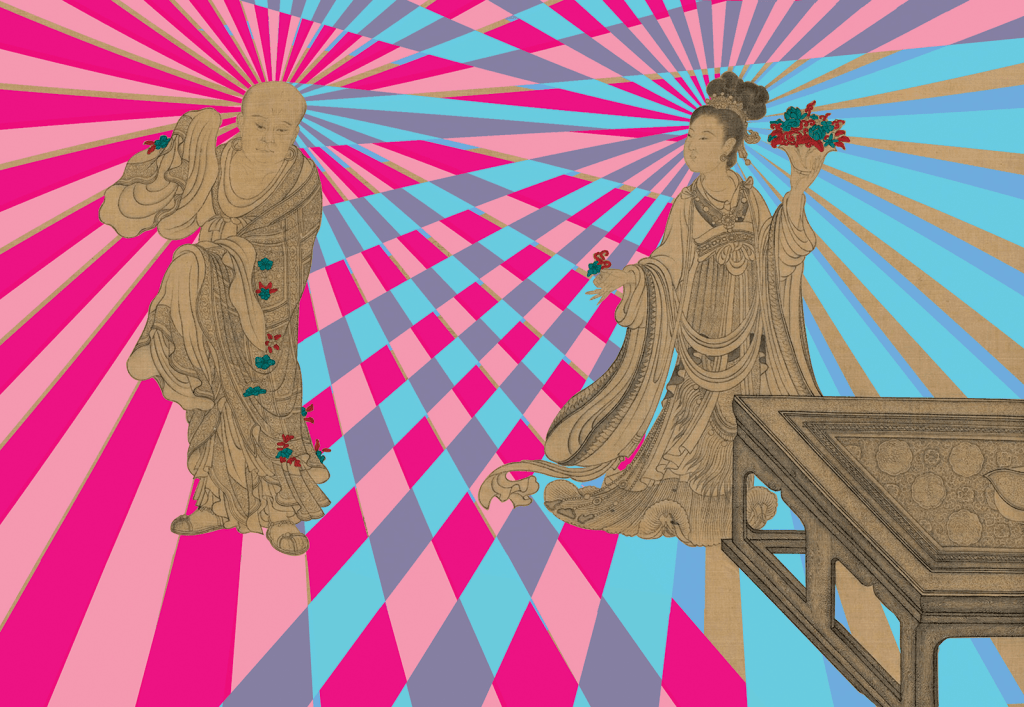
The passage in particular deals with a conversation between the monk Shariputra, one of the Buddha’s top disciples, and a spirit (simply called “The Goddess”) living in Vimalakirti’s house. After a long conversation where the goddess consistently demonstrates the superiority of her wisdom to the wisdom of the renunciate monk, Shariputra gets frustrated, abruptly changes the subject and tries to make the argument personal, a cheap move which backfires spectacularly:
Shariputra said, “Why don’t you change out of this female body?”
The goddess replied, “For the past twelve years I have been trying to take on female form, but in the end with no success. What is there to change? If a sorcerer were to conjure up a phantom woman and then someone asked her why she didn’t change out of her female body, would that be any kind of reasonable question?”
“No,” said Shariputra. “Phantoms have no fixed form, so what would there be to change?”
The goddess said, “All things are just the same-they have no fixed form. So why ask why I don’t change out of my female form?”
At that time the goddess employed her supernatural powers to change Shariputra into a goddess like herself, while she took on Shariputra’s form. Then she asked, “Why don’t you change out of this female body?”
Shariputra, now in the form of a goddess, replied, “I don’t know why I have suddenly changed and taken on a female body! ” The goddess said, “Shariputra, if you can change out of this female body, then all women can change likewise. Shariputra, who is not a woman, appears in a woman’s body. And the same is true of all women-though they appear in women’s bodies, they are not women. Therefore the Buddha teaches that all phenomena are neither male nor female.“
Then the goddess withdrew her supernatural powers, and Shariputra returned to his original form. The goddess said to Shariputra, “Where now is the form and shape of your female body?”
Shariputra said, “The form and shape of my female body does not exist, yet does not not exist.”
The goddess said, “All things are just like that-they do not exist, yet do not not exist. And that they do not exist, yet do not not exist, is exactly what the Buddha teaches.”
It is really a remarkable passage. There was a biased belief in early Buddhism that women could not attain Buddhahood so long as they were born in a woman’s body. Shariputra’s question was meant to cast doubt on the goddess’ wisdom: “If you think you’re so wise and all-knowing, Ms. Goddess, then why are you a lady? If you’re so all powerful, then why don’t you appear as a man and enter final Nirvana?” The fact that this view was explicitly criticized in 2nd century India says a lot about the views of its anonymous author in relation to society.
Anyways, if you are the least bit aware of social issues these days, in the United States and elsewhere, you will know that queer people are under attack. It has never been easy to be queer, of course. But the far right has made a special point of scapegoating trans people right now because they have found that it riles up their political base and gets them to mobilize, donate and vote. It is no exaggeration to say that they want to exterminate trans people, and then, like most fascists, everyone else whose existence they find unacceptable.
The USA is also a highly religious country. Obviously this favors Christians above all other faiths. But the result is a very robust constitutional right to practice one’s religion as part of the 1st Amendment. Usually liberals and leftists think of this as a “conservative thing”: religious exemptions for vaccination, public schooling, discriminating against minorities, etc. But there is really no reason we could not turn this into a strength of our own.
The Satanic Temple is a religious organization which began as a parody of Christian paranoia but became something more over the years. They thrive on controversy, and so will take on controversial political issues, usually from a left-ish position. Recently they have launched a pro-abortion campaign, which claims that its members have a constitutionally protected right to receive “ritual abortions”, even in states which outlawed abortion following the Supreme Court’s overturning of the Roe V. Wade. Other, more conventional religious organizations have made similar arguments. At this time, the Satanic Temple’s challenges to state anti-abortion laws have been unsuccessful. But this raises interesting questions about the role of religious groups in preserving individual and collective liberties under the current legal regime.
As I said, trans existence is under attack. The religious right is behind the extermination campaign and the opportunistic politicians of both parties have taken up their crusade, either out of genuine conviction, greed, or cowardice. They have begun with smaller restrictions: banning gender-affirming bathroom access; forcing trans women into men’s prisons; banning trans athletes from gender-segregated sports; limiting access to hormone replacement therapy and sex reassignment surgery. But the end goal is to criminalize and eliminate trans identity entirely. Could progressive and even radical left religious groups unite in defense of transgender rights?
In “A Religious Right to Abortion: Legal History and Analysis” by The Columbia Law School Law, Rights and Religion Project, the authors list 5 criteria necessary for abortion rights to be protected as a religious freedom:
Sincerity: Claimants would have to prove that their beliefs are sincerely held, and they are not attempting to perpetrate a fraud on the court. Proof of sincerity could include a demonstration that they have acted on their religious beliefs consistently in the past, that they have previously framed their beliefs and activities related to abortion in religious terms, and that they are able to testify clearly and consistently about their religious beliefs and practices.
Religiosity: Claimants should be prepared to prove that their beliefs are religious rather than political or philosophical in nature. That said, the fact that a religious belief or act happens to overlap with a certain political ideology does not make the belief political rather than religious in nature.
Substantial burden: Claimants would have to prove that state laws regulating abortion impose a substantial burden on their religious exercise. The fact that plaintiffs disagree with a law for religious reasons is insufficient—they must demonstrate that the law restricts their ability to undertake religiously motivated acts, or requires them to act in ways that conflict with their religious beliefs.
Compelling interest: Once a claimant demonstrates a substantial burden on their sincere religious exercise, the burden shifts to the government to show a countervailing compelling interest in enforcing the relevant statute on the claimants requesting an exemption.
Least restrictive means: Finally, in order to prevail against a state RFRA challenge, the government typically must show that enforcing the state statute on the claimants is necessary to advancing its compelling state interest(s).
Now, I don’t know how a Buddhist defense of abortion would work, though I’m sure it would be possible. But I think that the above quoted section of the Vimalakirti Sutra could be used to defend the Buddhist right to gender non-conformity. All that is missing is a ritual practice
What that ritual practice might be I couldn’t say for sure. But I imagine that it could draw on this section of the Vimalakirti Sutra to affirm both the fluidity and non-essential nature of gender. Perhaps a ritual could be invented which is meant to be supportive of people beginning their gender inquiry and transition. Or perhaps gender transition/negation could be seen as a form of Buddhist practice, one in which the transgressive performance of gender serves as the meditation itself. The goal, in this case, would be to realize the Goddess’ insight that all phenomena are neither male nor female. Sounds rather Tantric, doesn’t it? And what is a “non-binary” gender identity than the embodiment of this profound principle of non-duality? Its public performance has a tangible effect on society at large: loosening people’s attachments to fixed views of identity, norms and appearances. This is a practice of compassion for oneself and all beings. Anyone taking on the risks and difficulties of this path should be supported by the entire Sangha without hesitation.
I’m sure there is a lot more that could be said about this topic. But I will end it there for now.
Below are a few articles and videos on transgender identity and modern Buddhism:

 No Selves, No Masters