Let us therefore trust the eternal Spirit which destroys and annihilates only because it is the unfathomable and eternally creative source of all life. The passion for destruction is a creative passion, too. — Mikhail Bakunin

1.
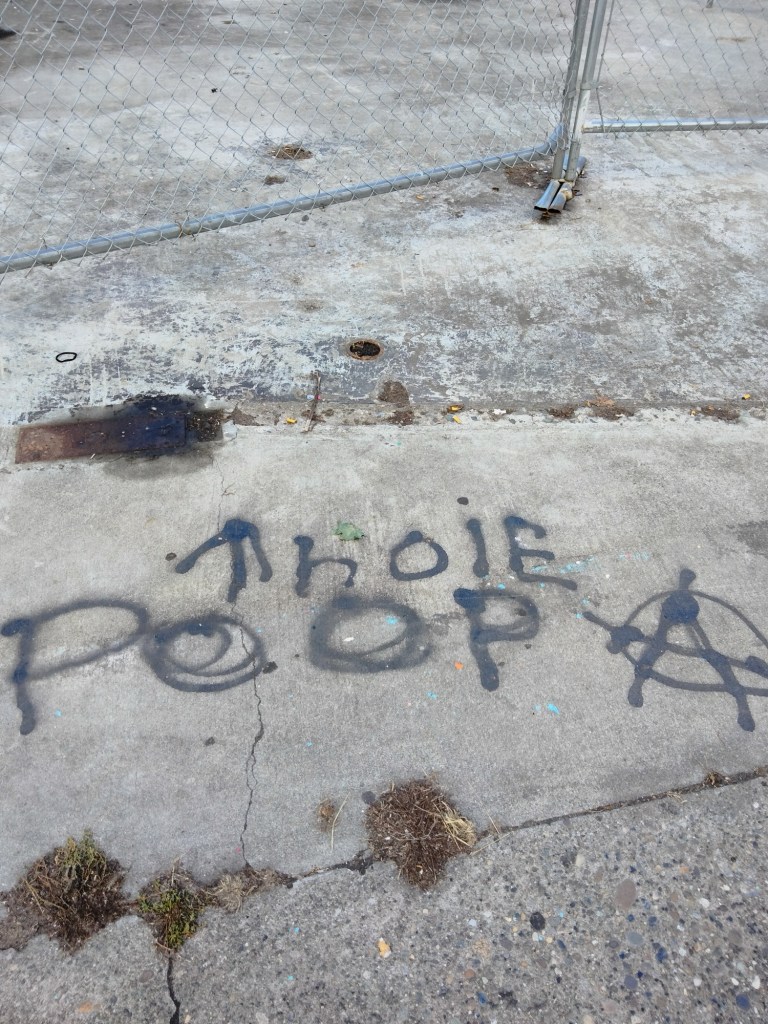
Love it or hate it, the “Circle A” — scrawled on walls, carved in bathroom stalls, printed on punk merchandise or painted on rebellious banners — is among the most widely recognized symbols of anarchy and anarchism. Learning to spray paint the circle A as a teenager is every bit as joyful and liberating (and annoying to adults) as learning the word “no” is for a toddler. Later on, if we grow up into “serious anarchists”, we might learn that it has a deeper symbolic meaning: the circle is not just a circle, but an “O”. “Anarchy is the mother of Order”, they say. Whether or not this is actually true is less relevant than the meaning it holds for militancy1. We’re not just here to rebel and destroy anymore: we want to build a new world in the ashes of the old. No more juvenile “fuck you” graffiti politics for us, thanks.
While this step into a deeper layer of symbolic interpretation is an important milestone, I believe that there is more that can be learned from this deceptively simple sign.
2.
Symbolism has a bad reputation in political philosophy, often for good reason. It is frequently associated with esoteric mysticism, elitism, and conspiratorial thinking. This is evident today in right wing politics, which use elaborate, yet ultimately nonsensical theories (think 666, Illuminati, New World Order, QAnon, etc.) to disable critical thinking and create scapegoats — all to distract regular people from the mundane but very real conspiracies of class warfare taking place before their very eyes.
An over-reliance on symbolism runs the risk of coming up with pointless and elaborate systems that lead into a maze of abstraction — maps which only refer to other maps and never the real — a wilderness of views, a tangled mess of red string connecting nonexistent points: madness this way lies. It is important to emphasize, that for Buddhism as well as anarchism, theory is always a theory of practice. Ideas are instrumental. The goal is not rational perfection, but liberatory experience: compassion, wisdom, freedom. Symbols work well when understood as tools in a toolkit for liberation. Like keys, lock picks, bolt cutters, blow torches, and so on, they are for flinging open the doors of the carceral mode of reality we find ourselves trapped in and nothing more.
So why bother with symbolism? First of all, there is no way to avoid it. Symbolism is as old as language — Language is itself symbolic, after all. And it seems that one way of understanding animal cognition, up to and including the human mind, is that brains are, among other things, metaphorical, analogizing, meaning-making organs. What we tend to call consciousness is what happens when the symbols “wake up” and start talking to each other.
Through dialogue and analogy — when something can be said to be “like” another thing, either by categorization or poetic metaphor — symbols become aware of themselves: they become thoughts. When a symbolic system becomes highly self-referential it creates an exponential feedback that Douglas Hofstadter called a “strange loop”2. This is how we can go from thinking about “this tall, hard, green and brown thing with food on it” to understanding the object as a “tree” which produces an edible sort of “fruit”, for example, “peaches”, and that it is one of many such “peach trees” which we can reliably distinguish from other trees by some shared characteristics. These are all examples of categorical abstractions which in no way “exist” in nature outside of minds. But can you imagine how impossible life would seem without them? The very act of language involves relating a abstract symbolic concept (“peach tree”) to a set of sounds, gestures or written marks such that it can be communicated to someone else (“Go and get me a peach from that peach tree in the corner of Mrs. Smith’s field”).
Symbols encode complex information into communicable packages (ideas) which another mind with a similar enough symbolic tool kit can then decode and interpret. In the process of interpretation ideas are transformed. Sometimes this creates entirely novel ideas, and thus thought evolves. The process is an unavoidable feature of organic communication. It is even characteristic of the semi-collective nature of brains: The right and left hemispheres have functional specializations, with one, the right, being the “experiencer”, and the left acting as the “symbolizer”. A simplified version of this theory would say that normal cognition consists of the right hemisphere experiencing and reacting to stimuli “non-conceptually”, passing this information off to left hemispheric regions for analysis, conceptualization, categorization and linguistic thought, and then feeding this information back into the right to be experienced as such. In this metaphor thought itself could be understood as a kind of symbolic exchange (a conversation, in other words) in which information is encoded and decoded by the brain in relation to its subsystems, the body and the environment.
Many Buddhists and other mystics claim that enlightenment consists of attaining a state of “non-conceptual awareness”. But I would argue that this is somewhat misleading. While it is quite possible (and necessary) to attain such states of non-ordinary consciousness, they are not “enlightenment” itself, which according to some is better thought of as a kind of practical wisdom gained from repeated contact with such states and its integration with the ordinary world of social-symbolic cognition. In the (self-proclaimed) highest teachings of Buddhism, the yogi learns to view samsara and nirvana as one inseparable experience, and are thus emancipated from any delusion that they are otherwise. This could also be thought of, in a crude sense, as a process by which the two hemispheres of the brain — the non-conceptual, experiential right and the verbal, symbolic left — become more connected and balanced. This view is supported by some imaging studies of functional connectivity between brain regions in experienced meditators.3
In order to teach, the Buddha had to find ways to communicate his experiential insights using symbols, analogies, metaphors, parables and skillful means. It is my hypothesis that the religious mode of communication is as influential and long-lived as it is because it has been successful at encoding extremely complex and abstract information within relatively simple and easily transmissible symbolic toolkits. These symbolic toolkits can also be used by adherents of a belief system as an interpretative cipher for day to day experiences, questions, anxieties, etc (I’m not an astrology person, but I think this is probably why people like it and other kinds of fortune telling). What’s more, symbols with sufficient analogical density (webs of nested associations to other symbols and layers of categorical abstraction) have a sort of “rabbit hole” (or “Tardis”) effect: They appear much larger on the inside than on the outside.
Modern Buddhists, as well as much of the radical left, have mostly failed to use symbolism, analogy and metaphor to their benefit, favoring instead lengthy and unpopular discursive arguments. But propaganda without theory or practice scatters seeds indiscriminately. It should be no surprise that most of them fail to grow.
When properly cultivated, symbols become “charged”. Through repetition and contemplation they accrete layers of abstract meaning to reach a critical density (when these symbols are represented by actions we call them rituals). Such ideological singularities are capable of bridging ordinary logic and a higher non-dual logic. These are the symbols we call “profound” and “mysterious”. They become capable of expressing a piece of the inexpressible. It is a bit like being able to represent 4-dimensional objects with 2-d versions of their 3-dimensional surfaces. The religious mode has made excellent use of this over the millennia, pointing, as it does, to profound and ineffable truths. Fundamental physics, which describes the inconceivable basis of matter and energy, must also resort to such symbolic systems, either in mathematics or metaphor. And yet what it describes is not less, but arguably more real than our everyday perceptual experience. And so, our minds are opened as our symbols become more and more sophisticated in relation to the real and to each other.
As our social and political world becomes more and more complex, our understanding must become capable of communicating a complex and interdependent social reality which hundreds of thousands of words alone could not. While the current social predicament is not exactly “ineffable” at times it feels like it requires no less than multiple graduate degrees to make sense of.
3.
If we, having embraced the “O” of order, then allow it to be once again overcome by the “A”, then the infantile “no” represented by the A of anarchy becomes capable of overcoming itself, opening up new horizons for the development of freedom. So what is it about the symbolic nature of A which allows for this infinite regression to take place, and what does this have to do with revolution and freedom? A particularly enigmatic Buddhist sutra may be the key:
Homage to the Great Mother Prajñāpāramitā!
Thus have I heard:
At one time the Blessed One was dwelling in Rājgṛha at Vulture Peak mountain, together with a great gathering of twelve hundred and fifty monks, and a great gathering of myriad bodhisattva mahāsattvas.
At that time, the Blessed One said to venerable Ānanda:
O Ānanda, since The Perfection of Wisdom ‘In One Syllable’ will bring benefit and happiness to sentient beings, please remember it!
It is like this:
A
When the Blessed One had said this, Venerable Ānanda together with all the monks and bodhisattva mahāsattvas realized the perfection of wisdom. They rejoiced, and thus praised the speech of the Blessed One.
This is the entirety of The Perfection of Wisdom, Mother of All Tathāgatas, ‘In One Syllable’ Sutra4. This is the shortest text in the vast Prajñaparamita literature. Works in this genre range from “a single syllable” to hundreds of thousands of lines of prose and verse.
So, you ask, what on Earth does this mystical mantra have to do with those irritating anarchy brats tagging my nice suburban fence, trash can, car, dog, or anything else they can get their hands on? And what could it possibly teach us about revolutionary theory?
Maybe everything, I think. Or at least half.
4.
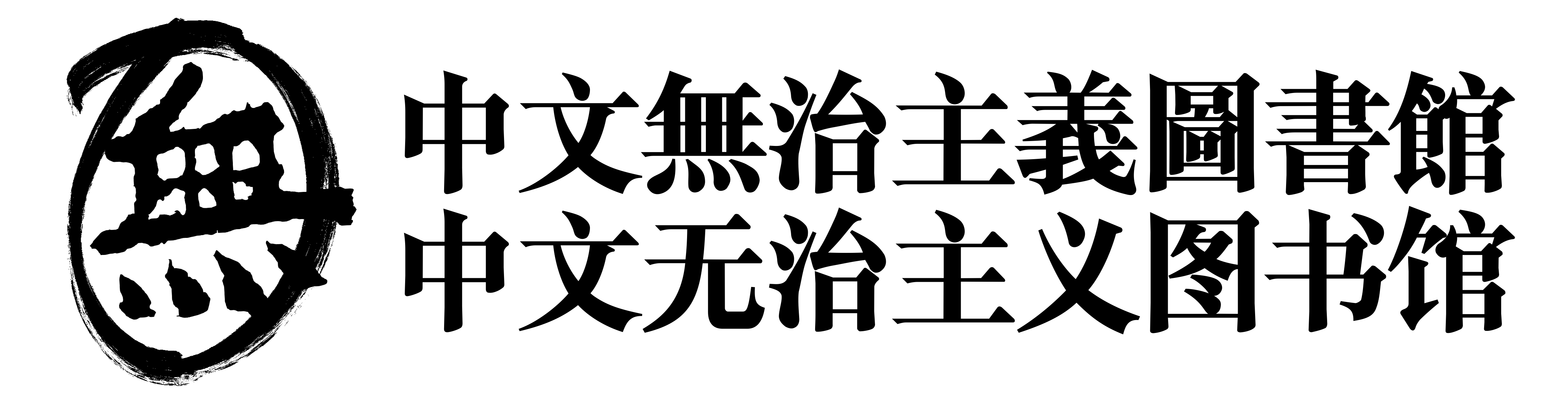
Let’s go back to the roots. In almost every Indo-European language, “a-“5 is the first sound a newborn baby can make and the first letter of the alphabet’; it is the sound of an unformed thought; it is a word indicating “one”; it is also a prefix which, much like the aforementioned graffiti, negates any concept it is tagged onto. Think: ahistorical; asymmetrical; abiotic, etc. This principle also extends to the prefixes “an-” (when it comes before a vowel) from which we get “anarchy” (non-rule), and so on. It’s also worth mentioning here that the Chinese character無 (wu/mu) has the same grammatical function as A/an-. This is why it usually translated as “non-” or “not-” rather than “no”. In fact, a Chinese-language anarchist library has adopted a “circled 無” as a translation for the typical anarchist symbol.
The absurdity of replying “無” without an object to negate is the point of famous koan, “Zhaozhou’s Dog”. When asked about the dog’s alleged Buddha-nature, the master could have just as well replied with the One Syllable Sutra: “A”.
This negative prefix part originally caught my attention when I was first designing this blog. Originally, the name “No Selves, No Masters” was just supposed to be a placeholder, a cliche parody of the anarchist slogan “No gods, no masters” and the Buddhist concept of anatman, or non-self. Curious, I thought, that anatman and anarchy share this same prefix despite being from very different languages6.To my surprise, though, this satirical symbolism highlighted deeper similarities between (or rather, beneath) the ideologies themselves. I’ve already written at length about one of these lines of convergence. Here, we are going to take the idea in a slightly different direction.
While the similarity between words from as different languages as ancient Greek and Sanskrit may seem superficial, the function of this connection is incredibly important. The function of “a-” is to negate. In theory, anything and everything could be negated by “a-“. Negation can even negate itself. In fact, for it to really be negation, it must.
But wait, if negation negates itself, doesn’t that make it positive? It would seem that we have accidentally unearthed a linguistic chain reaction which is on the verge of going critical.
5.
Negation has been a mainstay of philosophical inquiry East and West for thousands of years, and has been generating infinite innovation and controversy from the word “no”. Heraclitus and Nagarjuna are among the most famous thinkers of negation in the ancient world.
Heraclitus, a Greek contemporary of the Buddha, developed a dialectical philosophy based on the concept of impermanence. He is the “change is the only constant” and “the same man doesn’t step into the same river twice” guy. Impermanence is of course none other than the negation of permanence. Because change is a constant, all things are constantly in dialogue with their opposites, forming a sort of conceptual unity. And so, for Heraclitus, “All things come into being by conflict of opposites.”
Dialectical thought was also taken up by Plato, Aristotle and subsequent medieval thinkers. But for them dialectic was more limited in scope: a means of discerning truth purely through rational argument and dialogue between opposing views. A radical revival of Heraclitus’ dialectic was instigated by the German philosphers Immanuel Kant, and most famously George Wilhelm Frederick Hegel. For Hegel, like Heraclitus, negation a central feature of consciousness and even reality: “Thinking is, indeed, essentially the negation of that which is before us.” Two disciples of Hegelian dialectic, the infamous Karl Marx and Mikhail Bakunin7, would later apply dialectic to politics, leading to a theoretical radicalization of the early socialist movement and creating its two most famous currents: Marxism and anarchism. Socialism, its proponents argued, could free society from all bondage and suffering.
Nagarjuna, for his part, elucidated “emptiness” (śunyatā), a concept of universal negation derived from the earlier concept of no-self (anatman) which would become the core of the Mahayana Buddhist worldview and path to enlightenment. Realization of emptiness, in the Mahayana view, is the insight which frees sentient beings from all bondage and suffering.
It is no coincidence that Buddhism and anarchism are frequently accused of (and vigorously deny) nihilism. While nihilism actively believes in an existent “nothingness”, we would retort, “We don’t believe in nothing!”8.
What could it be about something as simple as negation that produces such radical ideas? This is a great and profound subject for meditation.

Freedom is the common goal of Socialism and Buddhism. Sometimes they will obscure this with jargon, but it is what they actually mean by words like “liberation”, “enlightenment”, “revolution”, “communism” and all the rest. Some theorists prefer to make a distinction between material and spiritual freedom (sometimes called “horizontal” and “vertical”, respectively. More on this here). But the Zen priest and anarchist Ichikawa Hakugen opposed this duality, writing that,
“In the place of dynamic unity of these two types of freedom we confront the problem of Zen freedom and social justice. We should not negate the wisdom of the [religious] state of mind by virtue of which one lives freely in places that lack freedom, nor scorn the effort, while living in the contemporary culture of commercialism, to work as free from this logic of commercialism as possible — in Linji’s terms ‘not getting confused by one’s surroundings’ and ‘freely availing oneself of one’s surroundings’”
By this Ichikawa means that the dichotomy between these dimensions of freedom is a false choice. It is equally important, he stressed, to be able to access a “vertical” freedom of the mind, especially in situations where one’s material freedoms are restricted, as well as the “horizontal” freedom to exist and act in the world according to one’s reason and desire. To “not get confused by one’s surroundings” means to not mistake the world of form for something real, permanent, or graspable; to not be taken in by ideological constructs which dictate the form of our thought. To “freely avail oneself of one’s surroundings” means to act in any situation as if one were already free and to work diligently to enlarge the space of social possibility for collective freedoms to flourish. The “dynamic unity” of these freedoms are the actions of body, speech and mind one takes on the path to liberation in whatever situation one finds oneself in. The basis for this dynamic unity is emptiness, which is neither horizontal nor vertical. This is why Ichikawa sometimes called his religious-political theory “Sunyata anarchist communism”.
Besides the dimensions of horizontal and vertical freedoms, there are negative and positive forms of freedom. There is “freedom from”: suffering, oppression, delusion, exploitation, etc. There is also the “freedom to” do something else: be happy, express yourself, make mistakes, create, develop and be well. Both of these represent two sides of the same coin. The existence of a “same coin” points to the existence of an integrated, “non-dual” form of freedom, the gist of which is “being able to act always according to one’s will, without ever being obstructed or bothered by anyone. That is, it means to respect one’s own will while at the same time respecting the will of the others, and to live in peace.”9 In this space beyond vertical and horizontal, positive and negative we find that “complete” freedom is a lack of obstruction mediated by interdependence10. It is a space of yet-to-be defined possibility connected to action. A space of openness. You might even say an emptiness.

But, you object, before getting so vague and abstract, you need to justify the emphasis on “freedom” as a good to strive for? After all aren’t there other, more relevant values we should focus on in the modern world? And what about other ideologies which also center freedom as their goal and quite obviously miss the mark? After all, isn’t the U.S.A.’s whole schtick “Freedom”? What about the ultra-capitalist so-called “Libertarians”? What about Marxist-Leninism? Mainstream Buddhism? Christianity?
This is a fair criticism. But in my understanding many ideas which claim to champion freedom are better understood as systems which institutionalize the human fear of freedom while “protecting” their subjects from it. In which case most of Buddhism and a good deal of anarchism also miss the mark. The “freedom” embodied by Capitalism and worshipped by the United States is an unchecked positive freedom: you are “free” to do anything, to anyone, at any time. Including oppression, exploitation, and setting up a legal system which protects the freedom of parasitic oligarchs at the expense of everyone and everything else, which is itself the self-negation of individual liberty. In the capitalist world, the words “freedom”, “liberty”, and even anarchy have been appropriated and turned into their opposites. Positive freedom’s other side, negative freedom, is purely restrictive: a system of rules, norms, regulations, taboos and other systems of control meant to protect the rights of the weak. In reality, because this level of control is impossible, an authoritarian system, whether the totalitarian bureaucracies of state “communism” or the rigid and punitive norms of so-called “woke” or “cancel” culture, ends up institutionalizing itself and transforming into domination as well. Our problem is not freedom, but an imbalanced conception of it. This is why Ichikawa’s move to ground freedom in and as emptiness is so necessary. No matter how well intentioned, purely negative or positive freedoms can only result in their opposites. The natural social expression of an “empty” or non-dual freedom could be described as a libertarian-socialism. The very term “libertarian-socialism”, an apparent contradiction to the “unenlightened”, is perfect example of the practicality of non-dual wisdom.
So, if the answer to the dilemma of freedom is so simple, why is freedom still so frightening to so many people? Freedom is frightening because we are ignorant of it: we think it is something other than what we really are. Viewed as something “other” it is frightening because it is emptiness; It is space; It is change. It is pure possibility. Reality in the raw, so to speak. And reality can kill the fuck out of you at a moment’s notice for no reason whatsoever. It doesn’t make sense, it doesn’t mean anything and it doesn’t care about you any more than you care about it. It is truly terrifying stuff for sentient little squishy meaning-making organisms such as ourselves. This is that old Nietzschean terror of the void staring back at you.
But freedom, emptiness and reality cannot be contained as mere “voidness” — they are everything else too. In Buddhist terms, tathata or “suchness”: The morning dew in a spider web. A dog’s wagging tail. The smell of your best friend’s house growing up. The burning down of a hated police station. The smoke rising into a clear blue sky. The absolutely unfettered and unfiltered joy of a single moment of pure, open awareness. As Ogasawara Hidemi wrote, emptiness is experienced in the moment of awakening as a “Cheerful empty heart; Warm, dripping sky light”.
Freedom is only freedom when we accept it all, including the good and the bad and everything in between. It is about taking responsibility for our world and our lives because the two are not two (nor are they just one).
And mere individual autonomy could not begin to describe the unlimited, exponential freedom of association. The freedom of a single individual, no matter how powerful, is pitiful in comparison to the collective freedom of millions to do things which no single person could ever hope to accomplish. To realize this kind of freedom we need empathy. We need ethics in order to voluntarily limit ourselves out of a respect for the freedom of others. Only then can we (as in all sentient beings) become limitless.
And so we come back again to negation. To be limitless means to negate any and all limits. But you’re telling me that to be limitless we have to limit ourselves? Bullshit!
What is the word “limitlessness” but another limit? What right has it to define the edges of the sky?
Freedom is that which is self-overcoming; that which always evades definitive capture by conceptualization; enlightenment, plain and simple. It is the fact that there is always another way out, always another move. It is the literal means of “thinking outside the box”. It means never getting stuck, even by ideas about freedom. “By not holding to fixed views, The pure-hearted one, having clarity of vision, being freed from all sense desires, is not born again into this world.”11
Other views of freedom, even the sincere ones, never take it all the way. Everyone and every system has a a limit to how much “freedom” they can handle before getting spooked. This is natural, of course. Freedom can be frightening. But it is also natural for some to want to keep going well beyond the limit which their society or temperament has defined as “safe”. Only a Buddha, they say, has fallen so far into emptiness they they become the sky. And who knows, maybe there’s even farther to go beyond that. “Gone, gone, gone beyond / Gone beyond beyond…”12.
If there is a purpose to Buddhist-anarchist practice, it is this: To lose our fear of freedom.
The dilemma of suffering identified by the four noble truths could be rephrased as: “There is fear. The cause of fear is ignorance of the radical nature of our freedom. But there is a path leading to freedom from this fear…” I say this because, while it is a great incentive to get your ass out of class and started on the path, “freedom from suffering” is more like a side effect of enlightenment rather than the thing itself.13
We are afraid of pain, we are afraid of death, and we are afraid of other people’s opinions about us. We can’t do anything about these facts of life, so we live in denial and try to control everything14: We do this by clinging on to what comforts us but is impermanent; we do this by identifying with that which has no true self; we do this by hating that which we fear about others. And so, in our infantile terror, we attempt to dominate the world and in doing so end up isolating ourselves (psychologists call this “compensatory control”). Tragically, this only makes the fear worse, and so we turn up the domination just a little more… The rest is, as they say, history.
This clip is from the 2025 film, “One Battle After Another”, which is an unconventional action movie about washed up Weather Underground-esque leftist militants having to defend their communities and families. Benicio del Toro’s character, despite being in a supporting role really steals the show. He plays a karate teacher and community organizer who runs an immigrant underground railroad from his dojo. I recommend that everyone watch it. I think his line here really summed up everything I want to say.
6.
Now let’s circle back around to the matter of “A”. We have explored the relationship between negation, represented by “a-” and emptiness/freedom. What about the other attribute, that of “coming first”?
It is not for nothing that the first letter of many alphabets has a negative connotation. After all it is not just freedom that is negative, but consciousness itself. Think of it this way: Is your conscious experience at this moment inclusive of absolutely every aspect of reality simultaneously? While reading this are you also noticing the cosmic rays passing through your body? The mad dashing of up and down quarks, gluons and the rest inside the points of matter we call protons and neutrons? The random temperature fluctuations in the room around you? The gravitational wave rippling through the fabric of spacetime in our spiral arm of the galaxy? The thought of tonight’s dinner passing through the brain of a fisherman off the coast of Portugal? (unless you are that fisherman, in which case, what’s cooking?)
If you are like me, then your answer couldn’t be anything but no (though I do encourage everyone to try being aware of these things. You never know). This is because consciousness is negative. It is a system for not perceiving things. This is why Buddhas are said to be “omniscient” and sentient beings are not: because Buddhas understand that “they” are not separate from “anything” there is nothing “they” do not “know”.
The philosopher Thomas Metzinger describes consciousness as an “ego tunnel” which allows an organism to find survival-relevant signals in the overwhelming noise of absolutely everything all at once by modeling a simplified version of reality, including itself, to itself15. The “walls” of this tunnel have the illusion of transparency, so we don’t usually know that we are a tunnel. But the information that makes it through is far less than the information which is filtered out. What little does enter the view of the tunnel is heavily distorted and transformed by evolutionary pressures into something we call “abstract concepts”. Abstraction and conceptualization are models which organisms use to categorize and make sense of the world. One of them is called “me” and another is called “you”.
In light of this, we might revise the first words of creation in the Bible, from the perspective of “mind”, like this: “Let there be NOT.”
Reality, independent of consciousness, contains no negativity. Whatever is just is, including nothingness. Distinction, much less meaning, is meaningless to it. Negation of what is, the first act of freedom and consciousness, creates space for the non-existent to become itself, and eventually to overcome that becoming. Eihei Dogen wrote that, “Before one studies Zen, mountains are mountains and waters are waters; after a first glimpse into the truth of Zen, mountains are no longer mountains and waters are no longer waters; after enlightenment, mountains are once again mountains and waters once again waters.”
Being without emptiness is not “being” as we know it. It is determinism. It is slavery. It is samsara. Mountains can never come to be, much less evolve into “not mountains” and eventually the “just mountains” of suchness.
This is why, in Chapter 24, verse 14 of the Fundamental Verses on the Middle Way, Nagarjuna wrote:
All is possible when emptiness is possible.
Nothing is possible when emptiness is impossible.
This is also what Hegel meant when he described being as becoming.
Another Western philosopher to approach this topic seriously was Jean Paul Sartre. In his aptly titled Being and Nothingness Sartre describes consciousness as “not what it is.” Consciousness, for Sartre, is the emptiness of freedom16.
Sartre identified the natural fear of freedom as “bad faith”: a conscious self-deception which allows us to avoid responsibility. From the point of view of bad faith, we are “condemned” to be free, and so most of our lives are spent trying to escape the freedom which is our true nature. Psychoanalyst Erich Fromm understood that the impulse towards authoritarianism and social conformity is a reaction to our fear of freedom: it is return to childlike dependence; a retreat into social sadomasochism; a substitute for accepting the adult responsibility of positive freeodom and the uncertainty that comes with it.
We claim to love and desire freedom; with another we desperately try to avoid the void of meaning and possibility which is its nature. It’s hard not to equate this dilemma with the problem of dukkha (suffering) identified by the Buddha as the malady his method was made to overcome. But what if the point of Buddhist practice in the modern world was a wholehearted acceptance of the “original freedom” of emptiness, rather than mere “freedom from suffering” or a purely egoistic “freedom to” ignorantly give in to the fears and cravings of the authoritarian Self?
Some schools of thought, such as Zen and Dzogchen, point students to the immediate and instantaneous realization of freedom. But they also recognize that for the vast majority of people this is not possible. To force this realization upon a person of ordinary capacity could even be dangerous to those it is meant to help. This dilemma — the immediate availability of freedom and people’s fear of and inability to accept it — is why Vajrayana Buddhism has developed such an extensive preparatory trainings for its initiates.
In Civilized Shamans: Buddhism in Tibetan Societies, Geoffrey Samuel writes that “The primary mode of activity of shamanic [Tantric/Vajrayana] Buddhism in analogy and metaphor.” Tantric trainings employ complex rituals, vocalizations, visualizations, and other feats of imagination to open the mind to radical possibilities (these possibilities range widely, from enlightenment to black magic). And yet, it is said that the entire point of this elaborate symbolic system is to ease the student into the realization that it was all illusory to begin with and that their freedom is immediately available should they choose to accept it. In this way Vajrayana practices are an excellent demonstration of symbolic-interpretive nature of the mind and the powerful effects these systems have on perception and cognition.
Kukai, founder of the Japanese Vajrayana tradition, Shingon, taught the importance of meditation on the letter A based on the Vairocanābhisaṃbodhi Sutra. He wrote that, “the principle of the letter A is that all natures (dharmas) are fundamentally unborn” and that “the sound A is the mother of all letters; it is the essence of all sounds; and it stands for the fountainhead of all-inclusive Reality.”
Kukai wrote in Meaning of the Word HŪM, that
Three ultimate meanings of the letter A can be identified:
a) being,
b) empty, and
c) uncreated.
The letter A in the Sanskrit alphabet represents the first sound. If it is the first [in contrast to others], it is relative. We therefore define it as “[relative] being.”
A also has the meaning of non-arising. If anything arises independence, it does not have its own independent nature. We therefore define it as “empty.”
By “uncreated” is meant the Realm which is one and real, that is, the Middle Way [Absolute]. Nāgārjuna said: “Phenomena are empty, temporal, and also middle…this single letter is the mantra of Mahāvairocana.”
A sūtra states: “The letter A signifies ‘the enlightened mind,’ ‘the gateway to all teachings,’ ‘nonduality,’ ‘the goal of all existences,’ ‘the nature of all existences,’ ‘freedom,’ and ‘the Dharmakāya.’” These are the ultimate meanings of the letter A. The same sūtra further elucidates the letter A”17
In the Shingon school a systematized form of meditation called ajikan was developed from Kukai’s teachings on A. In ajikan, students concentrate on a visualization of the Sanskrit letter A (𑖀) in the center of a white lotus moon disc. Gradually the disk expands to fill consciousness with light and the A-lotus centers itself in the meditator’s heart.
In the Jeweled Key to the Mysterious Storehouse Kūkai writes:
Those who understand the meanings of the letter A are to meditate on it resolutely; they should meditate on the perfect, luminous, and Pure Consciousness. Those who have had a glimpse of it are called those who have perceived the absolute truth (paramārtha). Those who perceive it all the time enter the first stage of Bodhisattvahood. If they gradually increase their competence in this meditation, they will finally be able to magnify it [the moon] until its circumference encompasses the entire universe and its magnitude becomes as inclusive as space. Being able freely to magnify or to reduce it, they will surely come to be in possession of the all-inclusive wisdom.

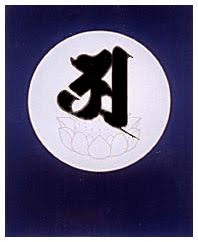
It is very tempting to suggest a variation of this meditation which replaces the Sanskrit A with Roman/English A. Such an experimental meditation on the non-duality of anarchy and order might begin something like: “While forming the anarchist mudra18, visualize an A in the circle of a moon disk, resting on a white lotus, spray-painted on the burning cop car of samsara”…
Some people would probably find this offensive. Not having tried ajikan seriously I couldn’t say if the idea transfers or not. Traditionalists are bound to say that it is important to use the Sanskrit letter 𑖀. Maybe it has magical powers that the Western mind could not comprehend. But I suspect that, like most letters, it is just a series of arbitrarily connected lines. Concentration meditation is about concentration, not the object. If the object has symbolic significance, so much the better. But in that case it is the idea, not the image which seems important. Personally, I think that meditating on a symbol of “anarchy-emptiness as the mother freedom and order” could be fruitful. If you try it, please let me know how it was for you.
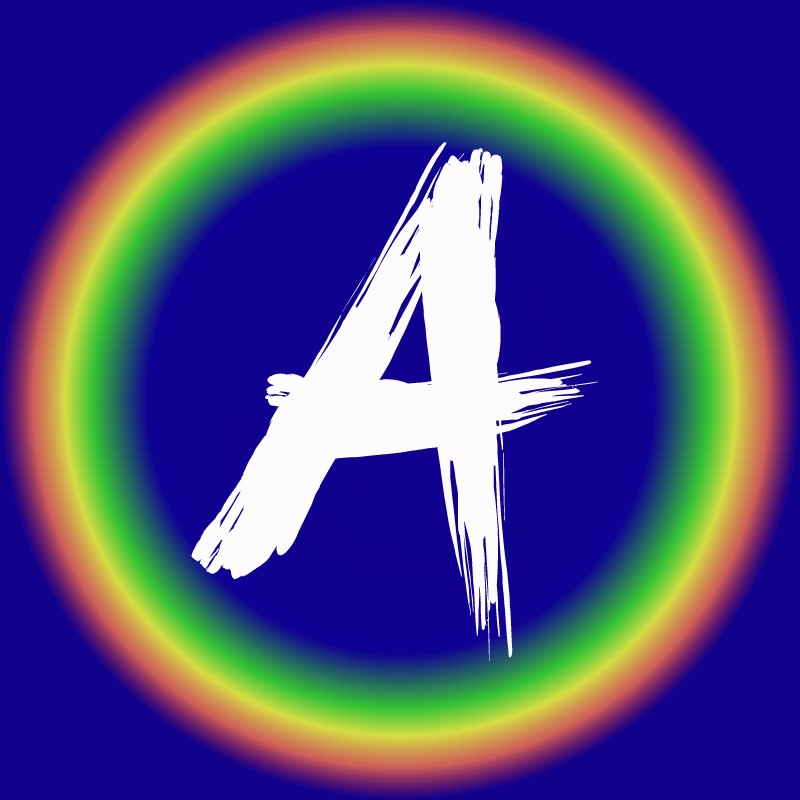
“A” is also significant to the Dzogchen tradition for similar purposes of contemplation. When doing background reading for my interview with Wei Kang I noticed that a lot of Dzogchen imagery employs the same device as ajikan, 𑖀 set inside a circular rainbow against the backdrop of an infinite blue sky-mind.19 So I made this (poorly edited) image:
7.
It may be the case that this “A” is an important bridge between Eastern and Western philosophies of freedom. Not only for its negative characteristics, but in its role as the origin and mother of order. Hannes Schumacher & Carlos A. Segovia write for Incite Seminars, “…beginning or principle (archē), which, due to its other meaning of authority, has overshadowed not only its very precondition –unbeginning (anarchia) or pre-cosmic anarchy – but also the potential of multiple beginnings (archai) capable of creating worlds from boundless possibilities. Or should it be the case that the very notion of beginning has been misconceived, misread, diluted over centuries, and now demands us to return to the very first beginning: the bright shining of the cosmos?”
Schumacher and Segovia raise an important point: The etymology of archē, the root of an-archy, indicates that a definite origin forecloses possibilities, and therefore freedom. Anarchy’s reinterpretation not only as “unrule”, but as “unbeginning” is remarkably similar to Kukai’s interpretation of A as the “uncreated”. It would seem that in the negation of beginnings we approach a sort of “a-primordial anarchy” which is identical to Buddhist notions of emptiness. In this uncreated space, “anarchy is the mother of order” means exactly the same thing as “form is emptiness / emptiness is form”.
Speaking of maternal relationships, Prajnaparamita is often spoken of as the “mother of Buddhas”; the rebellious White Lotus cults of medieval China worshipped Wusheng Laomu, the “birthless old mother” of all wisdom; Dzogchen master Garab Dorje’s three instructions summarizing the path of Dzogchen end with the verse, “Freeing itself by itself / Freeing one within unity / Uniting mother and child”; the first recorded word for “freedom”, the Sumerian amargi, translates literally as “return to the mother”20. In anarchist circles you will sometimes hear anarchy personified as “Mother Anarchy” I’m not exactly sure what to make of this, but it is clear that the primordial mother is an ancient and powerful symbol of liberatory negation. It would probably be a mistake to not connect these instances of her manifestation for contemporary purposes.
Ichikawa Hakugen too saw potential in the uncreated origin of emptiness. But unlike most philosophers and mystics, he found in them a practical ground for action. He called this stance “origin humanism”.
Rather than the “solitary aloofness” of Zen tranquility, Hakugen suggests that for the Buddhist anarchist, abiding equanimously in the more unpleasant contradictions of emptiness and form, rather than a blissfully empty “peace of mind”, is the aim of practice. He writes, “This original humanism will try to discover the significance of living as man, devoted to creating a contrary oneness of tranquility and un-tranquility, within the constant, individual or collective practice within actuality, in the dialectical process of theory and praxis.”
For the type of enlightenment a revolutionary, or even an ordinary working class person, ought to work towards this seems like more appropriate advice. We have not got the luxury of retreat and renunciation. We have work, families, struggles to attend to. Thus our practice is to be continuously distracted, agitated, disturbed and challenged at every step. Non-duality is not some delicate, high-class spiritual concept: it is a practical and everyday way of thinking 21. It can metaphorically be tossed about, covered in mud, forgotten behind the shed, but like a trusty old tool it is never broken by such abuses. Some literature in the Dzogchen tradition suggests that its durability can be made into a source of strength.
In the commentary to “The Special Teaching of the Wise and Glorious King“, Patrul Rinpoche writes:
There is a saying:
The more its flow is interrupted
The better the water in the mountain stream.
The more it is disrupted,
The better the meditation of the yogin.
So: Stillness, bliss and clarity: disrupt them, again and again.”
I think that it is no coincidence that political radicals appear to be disproportionately attracted to the schools of “immediate awakening” such as Dzogchen and Zen. Both appeal to sensibilities of “directness”, without mediation, in liberatory action and an innate attraction to openness, change, and ambiguity. Both (in theory) dispense with much of the metaphysical obfuscations which justify clerical authority. Both claim that the best time to get free is right now: they advocate a revolutionary overthrow of the sovreignty of ignorance. “The battlefield is this very body, this very life”.
8.
Symbols, analogies and metaphors are not trivial to political and religious practice — they are absolutely essential features. In my experience pedagogy which makes extensive use of symbols and metaphors is much easier to understand and can help ordinary people, not specialists, to intuitively embody complex ideas. We could write a 100,000 word treatise on anarchism, but we will not be able to spray paint it on a wall (much less get anyone to read it). Buddhists can exhaustively explain the liberatory power of emptiness in countless volumes of theory without enlightening more than a handful of scholarly monks. But isn’t it amazing that millions of words and hundreds of complex concepts can be understood in a single symbol: an A inside of an O? The best symbols are the ones which bear the same message, tailored for different audiences, at every layer of analysis: from a simple “fuck you” to the mysteriously non-arisen nature of phenomena and the luminously pure mind of bodhi.
It is said of the One-syllable Sutra that the Buddha never preached anything other than A, but that his skill was such that the infinite sentient beings heard the same sound as different teachings suited to their temperaments and capacities. The truth is always available in the superficial as well as the deep, and what appears as the deepest can also be the simplest. Depth is irrelevant anyways — from the perspective of wisdom, it’s all just surface. A wall is as good as the pages of a book for getting the point across.
Interpretation is a vulnerable endeavor because when we depart from the realm of clean-cut dictionary definitions we run the risk of being criticized by those who have a different view. But an essential part of practice is learning to have confidence in our intuition; to experiment and explore the depth of meaning even while understanding that there is not likely to ever be a “last word”, much less a first (and that this is actually a good thing!).
According to Kukai, learning to trust in the heart’s ability to make meaning is one way of understanding the entire path: “The Buddha Dharma is nowhere remote. It is in our heart; it is close to us. Suchness is nowhere external. If not within our body, where can it be found?” And as the author Ursula K. LeGuin wrote in The Disposessed, “You cannot buy the revolution. You cannot make the revolution. You can only be the revolution. It is in your spirit, or it is nowhere.” Freedom is ultimately not an abstraction. It is the true body of reality to which all our symbols point. Becoming it is the practice of liberation through the negation of the permanently existent. A is the spark that starts this chain reaction. A is a key to the gateless gate of samsaric incarceration. As beneath the paving stones, there is the beach — so beneath the appearance of a controlling, permanent, separate self, there is bodhi. Mountains are just mountains, rivers are just rivers.
The Buddha spoke this verse:
The magnet attracts iron filings.
Of the two, which is the self?
Because of the contradictions involved in non-extension and self-attraction
There is definitely no self.
It is like a thirsty person seeing a mirage:
Without water he generates the idea of water.
The false view of wrongly grasping the self—
This is to do the same.
By analyzing the letter A
It is known definitively that there is no self. 22
By analyzing the Ⓐ, it is known definitively that the reality of freedom is immanent in this world, this life, this very body and mind. Used skillfully, Ⓐ can transmit the entirety of the path. It is the symbol of great liberation. 84,000 Dharmas and 100,000 lines in a single syllable; the entire history of freedom in 5 strokes of the pen. By realizing Ⓐ, our original freedom, another world becomes possible. The next time you spot one, scrawled inelegantly on a dumpster, an alleyway, or a bathroom stall, take a moment to reflect on this and bow to this symbol of great wisdom, compassion and liberation.

Notes:
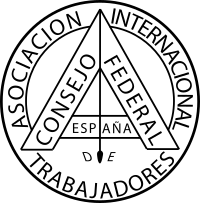
- The origin of the circle-A is somewhat mysterious. Historians of anarchism claim that it was either created by the French Jeunesses Libertaires (Libertarian Youth) in 1964 or it might have been derived from the logo of the Spanish section of the International Worker’s Association. The Spanish IWA logo may have more to do with Masonic symbolism, and it is well known that radicals have long held ties to occultism and secret societies. Tomas Ibañez claims to have invented the symbol in 1964, writing that its purpose was twofold: “to streamline and expedite the creation of wall inscriptions and posters, and secondly, to enhance the visibility of the anarchist movement within society by incorporating a common element shared across all anarchist expressions in the public sphere. Specifically, our objective was to minimize the time required for creating wall inscriptions by avoiding the need for lengthy signatures beneath our slogans while also selecting a symbol broad enough to be embraced and utilized by all anarchists. We believe the proposed symbol best fulfils these criteria. By consistently pairing it with the term “anarchist,” it will trigger associations with anarchism in people’s minds”. Ibañez claims that no deeper meaning such as “anarchy and order” (a concept which comes from a quotation by early libertarian theorist Pierre Joseph Proudhon) was intended, but that later anarchists gave it this meaning independently This is a clear example of symbols taking on a life and evolutionary trajectory of their own — as is this article. Ibáñez also said that they originally imagined the symbol in its more “punk” form, with the lines of the A escaping the circle. This is very appropriate for the explosively negative spirit of A: to overcome the very “order” it set into motion. It cannot, after all, be definitively contained. For more, see:
https://freedomnews.org.uk/2024/04/12/the-circled-a-at-60-true-and-false/ ↩︎ - See: Douglas Hofstader’s I Am a Strange Loop and Surfaces and Essences.
↩︎ - Some scientists say that humanity is suffering from symptoms of a “left brain dominance” syndrome: We are increasingly rational information processors, but we experience and understand less and less. This is probably why it feels like the people who have power over the world don’t fully comprehend it, and those who comprehend the world are seemingly incapable of attaining and wielding power. In theory, libertarian varieties of socialism like anarchism are meant to overcome this dilemma. But they have thus far failed to do so in practice. A failure in practice, despite repeated attempts, must have its root in a theoretical error. So if order doesn’t necessarily follow the rebellion of anarchy, what does, and why? How can we progress our understanding to more accurately reflect the situation we are confronted with? See: Ian McGilchrist’s The Master and His Emissary and Arnold Schroeder’s Fight Like an Animal podcast for discussions on hemispheric asymmetries and their social implications.
↩︎ - For a longer commentary on the One Syllable Sutra, see:
Doju talks on The Perfection of Wisdom Sutra In One Syllable ↩︎ - Pronounced ə (“uh”) as in “arena”. ↩︎
- It turns out, as is often the case, this similarity is due to this negative prefix descending from the Proto Indo-European root word *ne-. This ancient prefix is the ancestor of the Greek and the Sanskrit/Pali A/an- . English has such an alarming number of negative prefixes because it has borrowed them from Greek, Latin and Germanic sources, which all adapted *ne- differently. So we have not only A/An-, but also Un- (as in “unlock”), U- (as in “Utopia”), In-(as in “insubordinate”), Non- (as in “nonconformist”), Ne- (as in “negative”), and Ni- (as in “we want… a shrubbery!”). These all mean basically the same thing. Theoretically, this implies that we have the opportunity to create at least 6 new synonyms for anarchy, which would be fun. Let me know if you come up with any good ones. See: https://www.etymonline.com/word/*ne-. Another etymological detour worth taking here is the origin of the English word “emptiness” (once you start doing these kind of detours it’s hard to stop). From https://www.etymonline.com/word/empty (emphasis mine):
“Watkins explains it as from Proto-Germanic *e-mot-ja-, with a prefix of uncertain meaning + Germanic *mot- “ability, leisure,” possibly from PIE root *med- “take appropriate measures.” A sense evolution from “at leisure” to “containing nothing, unoccupied” is found in several languages, such as Modern Greek adeios “empty,” originally “freedom from fear,” from deios”fear.” “The adj. adeios must have been applied first to persons who enjoyed freedom from duties, leisure, and so were unoccupied, whence it was extended to objects that were unoccupied”.
↩︎ - I don’t quite know how to work this into an already lengthy and rambling essay, but I would like to include some quotations from Bakunin on dialectical politics here for the reader’s consideration. I find them to be incredibly illuminating as to the theoretical underpinnings of anarchism and its relation to the principle of negation which is the point of unity with Buddhist notions of freedom and the subject of this essay. Nevertheless the basic philosophical underpinnings of anarchism (called here the Negative Party) can clearly be seen:
“Contradiction itself, as the embracing of its two one-sided members, is total, absolute, true. One cannot reproach it with one-sidedness or with the superficiality and poverty which are necessarily bound up with one-sidedness, since it is not only the Negative, but also the Positive, and since, as this all embracing thing, it is total, absolute, all-inclusive fullness.
The whole significance and the irrepressible power of the Negative is the annihilation of the Positive; but along with the Positive it leads itself to destruction as this evil, particular existence which is inadequate to its essence. Democracy does not yet exist independently in its affirmative abundance, but only as the denial of the Positive, and therefore, in this evil state, it too must be destroyed along with the Positive, so that from its free ground it may spring forth again in a newborn state, as its own living fullness. And this self-change of the Democratic party will not be merely a quantitative change, i.e., a broadening of its present particular and hence evil existence: God save us, such a broadening would be the leveling of the whole world and the end result of all of history would be absolute nothingness – but a qualitative transformation, a new, vital, and life-creating revelation, a new heaven and a new earth, a young and magnificent world in which all present discords will resolve themselves into harmonious unity.
‘Revolutionary propaganda,’ says the Pentarchist, ‘is, in its deepest essence, the negation of the existing conditions of the state; for, with respect to its innermost nature, it has no other program than the destruction of whatever order prevails at the time.’ But is it possible that that whose whole life is only to destroy should externally be reconciled with that which, according to its innermost nature, it must destroy? Only half-men who seriously take sides neither with the Positive nor with the Negative can argue in such a fashion.
As a party we indeed stand in opposition to the Positives and fight them, and all evil passions are awakened also in us through this fight. Insofar as we ourselves belong to a party, we are also very often partial and unjust. But we are not only this Negative party set in opposition to the Positive: we have our living source in the all-embracing principle of unconditional freedom, in a principle which contains in itself all the good that is contained only in the Positive and which is exalted above the Positive just as over ourselves as a party. As a party we pursue only politics, but as a party we are justified only through our principle; otherwise we would have no better ground than the Positive. Hence, we must remain true, even contrary to our self-preservation, to our principle as the only ground of our power and of our life; i.e., we must eternally transcend ourselves as this one-sided, merely political existence in the religion of our all-embracing and all-sided principle. We must not only act politically, but in our politics also act religiously, religiously in the sense of freedom of which the one true expression is justice and love. Indeed, for us alone, who are called the enemies of the Christian religion, for us alone is it reserved, and even made the highest duty even in the most ardent of fights, really to exercise love, this highest commandment of Christ and this only way of true Christianity.
In the principle of freedom they see only a cold and prosaic abstraction – to which many prosaic and dry defenders of freedom have greatly contributed. They see only an abstraction which excludes all that is vital, all that is beautiful and holy.
They believe – and this belief is unfortunately still shared by many adherents of the Negative party itself – that the Negative tries to diffuse itself as such, and they think, just as we do, that the diffusion would be the leveling of the whole spiritual world. At the same time, in the directness of their feeling, they have a wholly justified endeavor toward a vital full life, and, since they find in the Negative only its leveling, they turn back to the past, to the past as it was before the birth of the contradiction between the Negative and the Positive. They are right insofar as this past really was in itself a living whole and as such appears much more vital and much richer than the divided present. Their great mistake, however, consists in this, that they think that they can recreate it in its past vitality; they forget that the past totality can by now appear only in the amorphous and cracked reflection of the present inevitable contradiction which that totality entails, and that the totality, as positive, is only its own corpse, with its soul torn from it, i.e., the corpse as delivered up to the mechanical and chemical processes of thought.
Let us therefore trust the eternal Spirit which destroys and annihilates only because it is the unfathomable and eternally creative source of all life. The passion for destruction is a creative passion, too.
The people, the poor class, which without doubt constitutes the greatest part of humanity; the class whose rights have already been recognized in theory; which, however, up to now is still condemned by its birth, by its ties with poverty and ignorance, as well, indeed, as with actual slavery — this class, which constitutes the true people, is everywhere assuming a threatening attitude and is beginning to count the ranks of its enemy, weak as compared to it, and to demand the actualization of the rights already conceded to it by everyone. All peoples and all men are filled with a kind of premonition, and everyone whose vital organs are not paralysed faces with shuddering expectation the approaching future which will speak out the redeeming word.
The Negative is justified only as this ruthless negation, but as such it is absolutely justified, for as such it is the action of the practical Spirit invisibly present in the contradiction itself, the Spirit which, through this storm of destruction, powerfully urges sinful, compromising souls to repentance and announces its imminent coming, its imminent revelation in a really democratic and universally human religion of freedom.
…It is of the utmost necessity that the human being . . . after he has lived long enough in rapturous self-contemplation and in intoxicating enjoyment of his individuality . . . awakens in himself the need for seeking the sources of life and
truth, the determining basis of his actions, and the abode of his tranquility, but
in a place that is different from his own individuality…The last phase and the supreme goal of all human development is liberty.”
Perhaps I will be able to work these in to a future version of this essay, or in another putting Bakunin and the Buddha into direct dialogue. Most of these quotations come from an early, pre-anarchist work of Bakunin’s, The Reaction in Germany, and Paul McLaughlin’s book Mikhail Bakunin: The Philosophical Basis of his Anarchism. ↩︎ - Nihilist anarchists would of course vigorously disagree. But like it or not they, are in the minority here. I would also like to point out, if it was not clear, that the sentence “we don’t believe in nothing” has a different meaning depending on which word is emphasized (we don’t believe in nothing; we don’t believe in nothing; we don’t believe in nothing; and so on with each word) Chose your favorite version and then try to guess which one is mine. ↩︎
- Quote from Uchiyama Gudo, in “Common Consciousness“. ↩︎
- Another complication here is the idea of free will. I don’t think free will, at least in the way it is conventionally understood, exists. Thanks in part to advances in psychology and biology, this is a less controversial stance than it used to be. I think that our lack of free will, ironically, is a step forward for freedom itself. What we think of as free will – independent, rational, abstract moral reasoning – is for the most part an illusion of the controlling “self” which keeps us trapped in all sorts of cycles of stupidity – karma, merit, sin, virtue, debt, value, guilt, blame, praise, shame, pride, success, and so on. While “we” probably do have some say over what the body does (mostly in terms of long term behavior change), it is never an independent decision. The free body is more akin to an anarchistic federation: Kropotkin wrote in Anarchism: Its Philosophy and Ideal, “When a physiologist speaks now of the life of a plant or of an animal, he sees rather an agglomeration, a colony of millions of separate individuals than a personality one and indivisible. He speaks of a federation of digestive, sensual, nervous organs, all very intimately connected with one another, each feeling the consequence of the well-being or indisposition of each, but each living its own life. Each organ, each part of an organ in its turn is composed of independent cellules which associate to struggle against conditions unfavorable to their existence. The individual is quite a world of federations, a whole universe in himself.” Freedom was never about you or me: it is about us. Freedom of the will, much like American notions of freedom, is a false freedom which we actually should free ourselves from. Freedom from will opens us up to the liberating realization that nobody, not even I, is in control or in charge. ↩︎
- Quote from the Karaniya Metta Sutta, translated from the Pali by the Amaravati Sangha. ↩︎
- From the Heart Sutra ↩︎
- Contrary to popular belief, enlightened beings still feel things. They just don’t get stuck. ↩︎
- “Denial” is another way of expressing the Buddhist critique of Ignorance. Ignorance can mean something as simple as “not knowing”. But I think it is equally important to recognize that it can mean “the state of ignoring”, which is an active denial of a plain and observable truth. In reality, what most people are ignorant of is their (active) ignorance (denial) of freedom. ↩︎
- Thomas Metzinger, The Ego Tunnel. ↩︎
- You could say, with no contradiction, that “I am what I am not”. This is the logic behind D.T. Suzuki’s seemingly illogical formula “A is not A, therefore it is A”. A thing which is essentially empty is definied by what it is not. When the things that it is definied by are similarly empty, what kind of identity can be arrived at? What if Anatman, rather than a mere negation of self-existence, instead implies that the self is affirmatively a “not” (as in the prefix A we have been discussing).It can be defined by what it is not because, like space, it is empty of intrinsic qualities besides “notness”: A little hole in reality which lets the freedom slip through. ↩︎
- Kukai qutoes from Ronald S. Green, “The Shingon Ajikan, Meditation on the Syllable ‘A’: An analysis of components and development” (2017)
↩︎ - The interlaced hands, symbolic of the anarchist spirit of “federalism, autonomy, solidarity and mutual aid” were used by the Spanish anarchist movement to distinguish themselves from the iconic “raised fist” salute associated with Marxists at the time. (See: https://cntasturias.org/en-defensa-de-nuestra-identidad/). While typically used as a form of salute, raised over the head, if placed in the lap during meditation this sign could also be used as a form of mudra (hand seal) to symbolize non-duality, compassion and interdependence. Experiment with this if you like. ↩︎
- In Initiations and Initiates in Tibet (1931), Alexandra David-Neel writes about a variety of spiritual exercizes which employ a vizualization of A, in which, “The novice imagines that in his heart there is an octagonal crystal vase containing a lotus with petals of the five mystic colours: white, red, blue, green, yellow. In the centre of the lotus stands the letter A, large in size and outlined in streaks of dazzling light.
He imagines another letter, white in colour, on the top of his head. From this letter emerge countless small white A’s which rush like a torrent towards the luminous A in the crystal vase, pass through it and return to the A on the head, forming an endless chain.” She notes that the described excercizes might seem “strange, even puerile”, but for the explanation of competent Lamas, who taught her that “the A in question is not a simple letter of the alphabet, rather is it the symbol of indestructibility, of existence without either beginning or end, or universal law. By concentrating his attention upon the letters flowing like the water of a river, the disciple finally conceives the idea of streams of energy flowing through himself, the idea of continual and mutual exchanges between himself and the outer world, the idea of the unity of that universal activity which produces here a man, there a tree, farther away a pebble, and a great many other ideas also, say those who practice these exercises.” ↩︎
From David Graeber’s Debt: the First 5,000 Years: “Faced with the potential for complete social breakdown, Sumerian and later Babylonian kings periodically announced general amnesties: “clean slates,” as economic historian Michael Hudson refers to them.
Such decrees would typically declare all outstanding consumer debt null and void (commercial debts were not affected), return all land to its original owners, and allow all debt-peons to return to their families.
Before long, it became more or less a regular habit for kings to make such a declaration on first assuming power, and many were forced to repeat it periodically over the course of their reigns.
In Sumer, these were called “declarations of freedom”—and it is significant that the Sumerian word amargi, the first recorded word for “freedom” in any known human language, literally means “return to mother”—since this is what freed debt-peons were finally allowed to do.”
Italics added by me to emphasize the thematic links to emptiness: the ability to declare nullity and voidness of debt further links the primordial-freedom-mother archetype to the concept of emptiness and its numerical offspring, the all-important zero, the etymology of which is linked to the Sanskrit śūnya, “empty”.
↩︎- Everyday non-dualism is simply the ability to consider multiple perspectives at once, or to say “both and” in response to a false dichotomy. It is how we deconstruct relative concepts, even in physical reality. If we couldn’t think in non-dualities we would not be able to understand fundamental principles such as the wave/particle nature of subatomic matter, for example. This doesn’t mean all dichotomies are false or that all perspectives are equally correct. Even less that the “middle way” between all extremes is the right view. Critical, non-dual thinking is a very practical tool for modern life, particularly in the analysis of social problems. It allows for a greater freedom of thought, and prevents getting stuck in the “either-or” thinking of stale sectarian politics. Bakunin writes, in The Reaction in Germany, “Nothing partial can use truth itself as a weapon, for truth is the refutation of all one-sidedness; whereas all one-sidedness must be partial and fanatical in its utterance, and hate is its necessary expression, for it can maintain itself in no other way than by opposing, through a violent repulsion, all other one-sidedness, even if as legitimate as itself. One-sidedness by its very presence presupposes the presence of other one-sidednesses, and yet, as a consequence of its essential nature, it must exclude these in order to maintain itself. This conflict is the curse which hangs over one-sidedness, a curse innate to it, a curse which transforms into hatred in their very utterance all the good sentiments that are innate in every man as man.” ↩︎
- From The Sutra of Majusri‘s Questions. ↩︎
 No Selves, No Masters
3 thoughts on “Circling the Ⓐ: Revolution in a Single Syllable”